


Summary
The success of an artificial intelligence project depends heavily on the quality of the data used to train its models. This guide explains where to find qualified data labelers, which skills they need, how to evaluate them, and which hiring channels work best for machine learning, computer vision, and natural language processing projects.
Want to see real profiles? Browse AI and machine learning engineers in Latin America with video and salary ranges on Interfell's talent search.
It also explores why Latin America has become a leading nearshore destination for U.S. companies building remote AI teams, thanks to its growing pool of skilled, English-speaking professionals and strong time-zone alignment with North America. Finally, it explains how Interfell helps organizations scale AI initiatives by connecting them with vetted remote data labeling professionals.
Table of Contents
-
Introduction
-
Why Data Labelers Are Essential for AI Projects
-
Where to Find Qualified Data Labelers
-
How to Build a High-Performing Data Labeling Team
-
Essential Skills Every Data Labeler Should Have
-
How to Evaluate Candidates for Machine Learning Projects
-
Why Hire Remote Data Labelers in LATAM?
-
Choosing the Right Hiring Model
-
Conclusion
-
Interfell Related Articles
-
FAQs
-
Quick Glossary
Introduction
A machine learning model is only as effective as the data used to train it. At the center of this process are data labelers—professionals who transform raw information into structured datasets that help AI systems recognize patterns and make accurate predictions.
Data labeling involves assigning labels to images, text, audio, video, and other data so artificial intelligence models can classify, detect, and interpret information correctly (IBM).
Although often viewed as an operational task, data labeling directly affects model accuracy, scalability, deployment speed, and return on investment. Poor annotations create unreliable models, increase retraining costs, and delay production. High-quality annotations improve performance, reduce bias, and accelerate development.
As AI adoption expands across industries, organizations increasingly need reliable data labeling teams capable of producing accurate datasets at scale.
Why Data Labelers Are Essential for AI Projects
Data labeling remains one of the most important stages of the artificial intelligence lifecycle.
Research consistently identifies data preparation and quality as major predictors of AI project success (Gartner). The Stanford AI Index Report 2025 also highlights the acceleration of enterprise AI adoption, which is increasing demand for professionals experienced in data annotation and machine learning workflows (Stanford HAI).
Modern data labelers are not simply completing repetitive tasks. Their work directly influences:
- Model accuracy
- Bias reduction
- Project scalability
- Training costs
- Dataset quality
- Deployment speed
Whether a company develops computer vision systems, NLP applications, document automation, or predictive analytics, annotation quality often determines whether the initiative succeeds.
With more than a decade of experience supporting organizations in the United States, Latin America, and Europe, Interfell helps companies build remote AI teams with professionals who meet both technical and business requirements.
Where to Find Qualified Data Labelers
Organizations can recruit data labelers through several channels, but each offers different levels of quality, scalability, and oversight.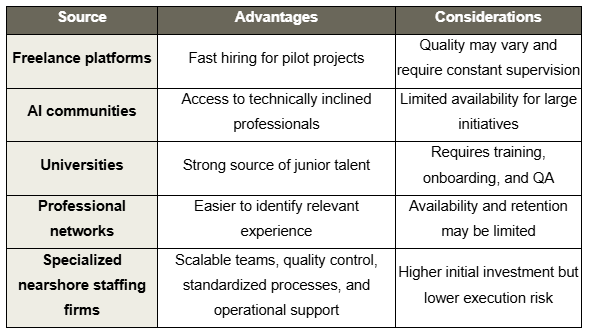
For projects requiring continuous production, confidentiality, SLA compliance, and consistent quality, a specialized staffing provider is usually the most reliable option.
Interfell provides access to a network of more than 2.5 million vetted professionals, simplifying the search for remote data labelers and AI specialists across different project sizes.
How to Build a High-Performing Data Labeling Team
To create a reliable data labeling operation:
- Define the type of data to be labeled.
- Establish annotation guidelines and quality standards.
- Evaluate candidates through practical exercises.
- Implement regular Quality Assurance reviews.
- Measure accuracy and consistency before hiring.
- Continuously train and calibrate the team.
- Work with a specialized staffing provider when rapid scaling is required.
A structured recruitment and quality-control process improves consistency from the beginning and reduces expensive annotation errors during model training.
Essential Skills Every Data Labeler Should Have
Not every AI project requires deeply technical specialists. However, strong data labelers consistently demonstrate several core competencies.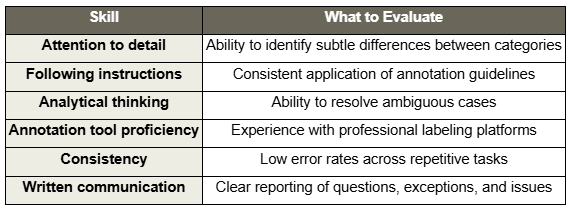
Depending on the project, relevant experience may include:
- Image annotation
- Text annotation
- Audio transcription and labeling
- Video annotation
- Document classification
- Natural Language Processing
- Computer Vision
Interfell also offers its Smart Hiring Salary Guide 2027 for Latin America, providing salary benchmarks and market insights for technology and AI-related roles.
How to Evaluate Candidates for Machine Learning Projects
Traditional interviews rarely provide enough evidence to accurately assess a data labeler. A stronger evaluation process should include the following stages.
1. Practical Assessment
Give candidates real or simulated datasets similar to those they will handle on the project.
2. Quality Review
Evaluate:
- Annotation accuracy
- Consistency
- Compliance with guidelines
- Error rates
3. Secondary Validation
Test candidates across multiple datasets to verify that performance remains consistent under different conditions.
4. Performance Metrics
Measure indicators such as:
- Accuracy
- Speed
- Consistency
- Productivity
- Learning ability
When hiring at scale, automation can improve efficiency and standardization.
Through its technology partner Simera, Interfell uses SPK—Simera Professional Key—an AI-powered candidate assessment solution designed to support objective and scalable hiring processes.
Why Hire Remote Data Labelers in LATAM?
Latin America has become one of the fastest-growing nearshore talent hubs for artificial intelligence and data operations. The region offers U.S. companies professionals who combine technical capability, cultural compatibility, competitive costs, and real-time collaboration.
Companies working on machine learning, computer vision, and NLP projects increasingly hire remote data labelers in Latin America because the region provides a strong balance of quality, scalability, and operational efficiency.
Its main advantages include:
- Strong English proficiency
Many data labelers and AI professionals in Latin America have a good command of English. They can participate in meetings, understand technical documentation, communicate with U.S. teams, and follow detailed annotation guidelines.
- Nearshore time-zone alignment
Latin American professionals work in time zones that overlap significantly with North American business hours. This enables real-time communication, faster feedback, and more agile project management than many traditional offshore models.
- Educated technology workforce
The region has experienced strong growth in AI, software engineering, data science, and technical education, creating a larger pool of professionals capable of supporting sophisticated machine learning projects.
- Competitive operating costs
Hiring remote professionals in Latin America allows U.S. organizations to optimize budgets while maintaining high quality standards and scaling projects more sustainably.
- Growing AI experience
More professionals across the region now have hands-on experience with computer vision, NLP, generative AI, autonomous systems, and large-scale annotation initiatives.
- Cultural compatibility
Similar business practices, collaborative work styles, and familiarity with U.S. corporate environments help distributed teams integrate more quickly.
For companies that need to expand AI operations without building large internal annotation departments, LATAM offers an attractive combination of technical expertise, operational flexibility, and nearshore collaboration (OIT).
With more than a decade operations across the United States, Spain and Latin America, Interfell helps organizations assemble distributed AI teams aligned with their technical requirements and long-term objectives.
Choosing the Right Hiring Model
Before selecting a hiring strategy, organizations should answer four questions:
- How large is the project?
- What level of accuracy is required?
- How much operational oversight will be necessary?
- How quickly must the team scale?
For proof-of-concept projects and smaller initiatives, individual freelancers may offer enough flexibility.
However, enterprise AI programs involving sensitive information, large annotation volumes, strict quality standards, or long-term production usually benefit from a specialized nearshore staffing partner.
An experienced talent provider reduces recruitment risks, accelerates onboarding, strengthens quality assurance, and provides the stability required to support expanding machine learning programs.
Conclusion
Finding qualified data labelers involves more than filling open positions. Companies need a structured process supported by practical evaluations, continuous training, and quality assurance practices that produce consistent, reliable datasets.
Organizations that invest in experienced annotation professionals can improve model accuracy, reduce retraining costs, accelerate deployment, and increase the overall effectiveness of their AI initiatives.
For U.S. companies seeking to scale efficiently, Latin America has become a leading source of nearshore AI talent, combining technical expertise, English-speaking professionals, overlapping time zones, and competitive costs.
With a network of more than 2.5 million technology professionals, AI-powered candidate assessments, and extensive remote recruitment experience, Interfell helps organizations build high-performing teams for demanding machine learning projects.
Looking to hire qualified remote data labelers?
Contact Interfell to discover how its nearshore recruitment solutions can help you build reliable, English-speaking teams specializing in machine learning, computer vision, NLP, and data annotation.
Interfell Related Articles
FAQs
1. What does a data labeler do?
A data labeler classifies and annotates images, text, audio, video, and other data used to train artificial intelligence and machine learning models.
2. What skills should a data labeler have?
Important skills include attention to detail, consistency, analytical thinking, the ability to follow guidelines, annotation tool proficiency, and strong written communication. English proficiency is especially valuable when working with U.S. teams.
3. Where can companies find qualified data labelers?
Companies can recruit through freelance platforms, universities, AI communities, professional networks, or specialized nearshore staffing firms that provide vetted remote professionals.
4. How should companies evaluate data labelers?
The most effective approach combines practical annotation tests with quality reviews measuring accuracy, consistency, speed, and compliance with project guidelines.
5. What is the difference between data labeling and data annotation?
The terms are often interchangeable. However, data annotation may refer to more detailed processes used in areas such as object detection, semantic segmentation, or natural language understanding.
6. Why hire remote data labelers in Latin America?
LATAM offers skilled professionals, strong English proficiency, overlapping working hours with North America, competitive operating costs, and growing AI experience.
7. When should a company use a specialized staffing partner?
A specialized partner is particularly useful when a project requires rapid scaling, secure data handling, SLA compliance, consistent quality, or reliable long-term operations.
Quick Glossary
- Data Labeling: Assigning labels to data so machine learning models can recognize patterns and generate accurate predictions.
- Data Labeler: A professional who annotates datasets according to project guidelines and quality standards.
- Dataset: A structured collection of information used to train, validate, and test AI models.
- Machine Learning: A branch of AI that enables systems to learn from data.
- Natural Language Processing: Technology that enables computers to understand, interpret, and generate human language.
- Computer Vision: An AI field focused on helping machines interpret images and video.
- Quality Assurance: Processes used to verify annotation accuracy, consistency, and dataset quality.