


Summary
Hiring data labelers in LATAM is one of the smartest ways for U.S. and Canadian companies to scale AI operations efficiently. Latin America offers competitive costs, time zone alignment with North America, strong English proficiency, and a growing pool of professionals with experience in data annotation and AI support.
Want to see real profiles? Browse AI and machine learning engineers in Latin America with video and salary ranges on Interfell's talent search.
In this guide, you’ll learn what data labelers do, which skills to evaluate, salary expectations in 2026, and how to build a reliable hiring process. You’ll also see why Interfell is a strong partner for companies looking to hire and scale nearshore data labeling teams in Latin America.
Table of Contents
- Introduction
- What Is a Data Labeler?
- Why Hire Data Labelers in LATAM?
- Key Skills to Look for in a Data Labeler
- Data Labeler Salaries in LATAM in 2026
- How to Hire Data Labelers in LATAM?
- Best Hiring Model for Scaling Data Labeling Teams
- Why Hire Data Labelers Through Interfell?
- Scale Your AI Projects With Nearshore Data Labelers
- Interfell Related Articles
- FAQs: About Hiring Data Labelers in LATAM
Introduction
Every strong AI product depends on high-quality data. Before a machine learning model can perform well, it needs training data that has been properly tagged, categorized, and validated. Data labelers do that work.
As demand for AI products continues to grow, companies are seeking efficient ways to expand data annotation capacity without sacrificing quality. That is why many organizations are choosing to hire data labelers in LATAM. The region offers a practical combination of affordability, real-time collaboration, and access to skilled remote talent that can support AI workflows at scale. (Bloomberg.com)
What Is a Data Labeler?
A data labeler, also called a data annotator, tags and structures raw data so machine learning models can learn from it effectively.
Depending on the project, data labelers may work with:
- Text: sentiment analysis, intent classification, named entity recognition
- Images: object detection, segmentation, bounding boxes
- Audio: transcription tagging, speech recognition tasks
- Video: event labeling, motion tracking, object classification
Their work directly affects model accuracy, consistency, and bias reduction. Even strong AI models underperform when the training data is poorly labeled.
Why Hire Data Labelers in LATAM?
Many companies hire data labelers in LATAM because the region combines affordability, talent availability, and operational compatibility with North American teams.
1. Cost Efficiency
LATAM data labelers often provide excellent value compared to local hiring in the U.S. or Canada. This is especially useful for businesses managing large annotation volumes or scaling fast-moving AI workflows.
2. Time Zone Alignment
Most Latin American countries overlap with U.S. and Canadian working hours. That makes real-time communication easier, speeds up issue resolution, and helps projects move faster.
3. Growing Tech Talent Pool
Countries like Mexico, Colombia, Argentina, Brazil, and Chile continue to expand their digital workforce. Many professionals in the region already support international companies in AI operations, data services, and technical back-office roles.
4. English Proficiency
For NLP tasks, multilingual datasets, and collaboration with global teams, English proficiency matters. Many LATAM professionals are used to working with English documentation and international workflows.
5. Scalability
Nearshore hiring in Latin America allows companies to expand annotation teams more quickly than local-only recruiting. This is valuable for startups and enterprise AI teams alike.
Key Skills to Look for in a Data Labeler
The best data labelers combine technical familiarity with execution discipline. Accuracy and consistency matter just as much as tool knowledge.
1. Technical Skills
Look for experience with:
- Annotation tools such as Labelbox, CVAT, Prodigy, or similar platforms
- Text, image, audio, or video labeling workflows
- Quality assurance and data validation
- Following detailed labeling instructions
- Basic understanding of AI or machine learning processes
For more advanced projects, experience with LLM evaluation, reinforcement learning from human feedback, or complex classification tasks can be a major advantage.
2. Soft Skills
Strong data labelers should also show:
- Attention to detail
- Accuracy and consistency
- Ability to follow rules and edge-case logic
- Clear written communication
- Comfort with repetitive, process-driven work
These qualities often make the difference between average and high-quality annotation output.
Data Labeler Salaries in LATAM in 2026
Salaries vary depending on experience, project complexity, language requirements, and country of hire. In general, companies can expect these monthly ranges in 2026:
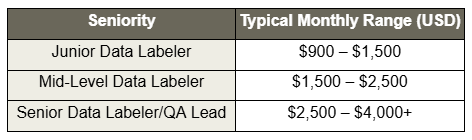
For North American companies, these ranges often offer a strong balance between cost efficiency and quality.
How to Hire Data Labelers in LATAM?
Hiring successfully requires more than reviewing resumes. Companies should assess precision, communication, and the ability to follow structured guidelines. (Phenom.com)
1. Define Your Data Scope
Start by clarifying the size and complexity of the project. Define:
- The type of data to be labeled
- Dataset volume
- Delivery timelines
- Accuracy expectations
- Whether the work is ongoing or project-based
A clear scope makes it much easier to identify the right candidate profile.
2. Create Clear Labeling Guidelines
Detailed instructions are essential for consistent output. Good guidelines reduce ambiguity, improve onboarding, and support long-term quality.
Your documentation should include:
- Label categories
- Edge cases
- Escalation paths
- Correct and incorrect examples
- Review and approval criteria
The clearer the instructions, the more reliable the results.
3. Test Candidates With Real Tasks
A short paid or simulated annotation test is one of the best ways to evaluate candidates before hiring.
This test should measure:
- Accuracy
- Speed
- Consistency
- Ability to follow instructions
- Communication when clarification is needed
Practical exercises provide better insight than interviews alone.
4. Implement Quality Control
Even skilled data labelers need a structured quality assurance process. Without QA, annotation drift and inconsistency can affect model performance over time.
A strong QC system may include:
- Reviewer spot checks
- Accuracy KPIs
- Feedback loops
- Escalation processes
- Ongoing performance monitoring
This is especially important for high-volume or sensitive AI use cases.
5. Choose the Right Hiring Model
The best hiring model depends on your internal resources, project size, and speed requirements.
-
Freelancers can work well for short-term projects, pilots, or low-volume tasks.
-
Remote employees offer more control, consistency, and retention for long-term needs.
-
Dedicated nearshore teams are often the best option for companies that need to scale quickly while maintaining quality and operational stability.
Best Hiring Model for Scaling Data Labeling Teams
If your company needs ongoing annotation support, quality assurance, and fast ramp-up, a dedicated nearshore model is often the most efficient option.
A reliable hiring partner can help with:
- Talent sourcing
- Screening and vetting
- English evaluation
- Payroll and contracts
- Compliance support
- Team scaling as demand grows
This reduces administrative work and allows internal teams to stay focused on product development and model improvement.
Why Hire Data Labelers Through Interfell?
Interfell helps companies hire remote talent in Latin America quickly and reliably, including data labelers, annotators, and AI support professionals.
We support hiring by:
- Pre-vetting candidates for technical fit and English proficiency
- Prioritizing communication skills and cultural alignment
- Managing recruitment and hiring logistics
- Helping companies scale nearshore teams with speed and confidence
Whether you need one data labeler or a full annotation team, Interfell helps simplify the process and improve hiring outcomes.
Scale Your AI Projects With Nearshore Data Labelers
If you want to scale AI products effectively, data quality has to be a priority. Hiring data labelers in LATAM can help your company reduce costs, improve operational efficiency, and build reliable annotation workflows that support long-term growth.
For U.S. and Canadian businesses, Latin America offers a nearshore solution with strong talent, real-time collaboration, and flexible team scaling. With the right hiring process and the right partner, building a dependable data labeling team becomes much faster and easier.
If your company is looking to hire data labelers in LATAM, Interfell can connect you with pre-vetted professionals who support NLP, computer vision, and other AI workflows across the region.
Interfell Related Articles
FAQs: About Hiring Data Labelers in LATAM
1. What does a data labeler do?
A data labeler tags and organizes raw data so machine learning models can learn from it. This may include annotating text, images, audio, or video according to specific project guidelines.
2. Why do companies hire data labelers in LATAM?
Companies hire data labelers in LATAM because the region offers competitive costs, time zone overlap with North America, growing technical talent, and strong collaboration potential for remote AI teams.
3. How much does it cost to hire a data labeler in Latin America?
In 2026, typical salaries range from $900 to $1,500 per month for junior roles, $1,500 to $2,500 for mid-level professionals, and $2,500 to $4,000 for senior labelers or QA leads.
4. What skills should I look for when hiring a data labeler?
Look for attention to detail, consistency, written communication, and experience with annotation tools like Labelbox, CVAT, or Prodigy. Experience in QA workflows or LLM evaluation is also valuable for advanced projects.
5. How can I test a data labeler before hiring?
Use a short paid or simulated annotation task. Review the candidate’s accuracy, speed, consistency, and ability to follow instructions and handle edge cases.
6. What is the best hiring model for data labeling teams?
That depends on your needs. Freelancers can work for short-term projects, remote employees are useful for long-term control, and dedicated nearshore teams are often best for companies that need to scale quickly without losing quality.
7. Why work with Interfell to hire data labelers in LATAM?
Interfell helps companies source, vet, and hire qualified data labelers in Latin America. We also support English evaluation, hiring logistics, and team scaling for AI and data annotation projects.