


Summary
Choosing between nearshoring and offshoring is no longer just about lowering costs. For U.S. companies, the real difference comes down to hiring speed, collaboration, talent quality, and the ability to scale without disrupting execution.
In this article, you will learn how nearshoring and offshoring differ, when each model makes the most sense, and why Latin America has become a strategic region for hiring remote tech talent.
You will also discover how Interfell helps companies hire faster and more effectively through specialized IT recruitment, remote staffing, payroll solutions, and advanced AI-driven talent evaluation.
Table of Contents
- Introduction
- What Is Nearshoring and What Is Offshoring?
- When Nearshoring Makes More Sense?
- When Offshoring Makes Sense?
- Why LATAM Has Become a Strategic Hiring Region for U.S. Companies?
- The Real Hiring Challenge: Finding the Right Talent Fast
- How Interfell Helps U.S. Companies Hire Better and Faster?
- Conclusion
- Interfell Related Articles
- FAQs
Introduction
Hiring globally is no longer just a cost decision. For U.S. companies, the real question is which model helps teams move faster, collaborate better, and scale without creating operational friction.
That is why the debate around nearshoring vs. offshoring matters more than ever. Both models can help businesses access international talent, but they are built for different priorities. One emphasizes speed, alignment, and real-time collaboration. The other is often designed around cost reduction and large-scale operational efficiency.
For founders, CTOs, and hiring managers building tech teams, the difference is critical. The wrong model can slow delivery, create communication gaps, and weaken execution. The right one can help your company scale with better talent, stronger integration, and more predictable results (objectstyle).
For many U.S. businesses, that is exactly why nearshoring in Latin America has become a strategic advantage.
What Is Nearshoring and What Is Offshoring?
Nearshoring means outsourcing services or hiring talent in nearby countries with overlapping time zones and stronger cultural compatibility. For U.S. companies, this usually means working with professionals in Latin America.
Offshoring means outsourcing work to more distant countries, often with larger time differences and more asynchronous communication. Companies usually choose this model when cost reduction is the main goal or when they need to scale highly standardized processes.
In simple terms, nearshoring brings talent closer to your company’s way of working. Offshoring typically lowers costs further, but it can also make collaboration more complex.
Nearshoring vs. Offshoring: Key Differences
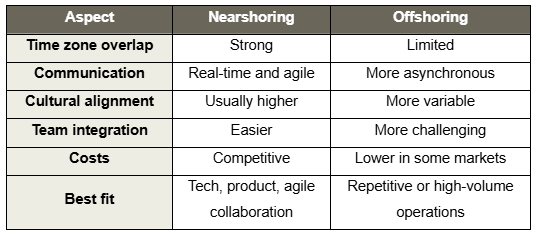
This distinction matters because execution speed depends on more than technical skill. Even highly capable teams can lose momentum if communication is delayed, priorities are misaligned, or collaboration becomes harder than it should be.
When Nearshoring Makes More Sense?
Nearshoring is ideal when your company needs more than just cost savings.
1. Real-time collaboration is critical
If your teams rely on agile workflows, standups, and fast feedback loops, LATAM talent can work in sync with U.S. business hours.
2. Roles impact product and business decisions
Positions like software engineers, DevOps, data specialists, and cloud architects require constant interaction and strategic thinking—not just task execution.
3. You want to scale without sacrificing quality
LATAM offers highly skilled professionals at competitive rates, creating a strong balance between cost and performance.
4. You are building long-term teams
Nearshoring supports sustainable growth by prioritizing alignment, communication, and retention—not just short-term hiring.
When Offshoring Makes Sense?
Offshoring still delivers value in the right scenarios.
It works best for:
- Repetitive or standardized processes
- Administrative and support functions
- High-volume operations
- 24/7 coverage models
However, it can introduce friction when work depends on speed, iteration, and close collaboration—especially in tech environments.
Why LATAM Has Become a Strategic Hiring Region for U.S. Companies?
Latin America has become one of the most attractive regions for companies hiring remote tech talent. For U.S. employers, the appeal is both practical and strategic.
-
High-quality talent at competitive rates
The region offers experienced developers, QA engineers, DevOps specialists, and data professionals with strong technical and soft skills (crazyimagine).
-
Time zone alignment
LATAM allows real-time collaboration, unlike distant offshore regions.
-
Cultural compatibility
Professionals in the region are familiar with U.S. business practices, agile methodologies, and remote work environments.
-
Scalable growth model
Many companies use LATAM nearshoring as the foundation of their global hiring strategy (globaltrademag).
The Real Hiring Challenge: Finding the Right Talent Fast
Understanding nearshoring is easy. Executing it successfully is not.
The real challenge is:
- Finding top-tier candidates
- Validating skills accurately
- Hiring before competitors do
Top LATAM talent is in high demand. Slow processes lead to missed opportunities. High volume does not guarantee quality.
Companies don’t just need access to talent—they need precision, speed, and better decision-making tools.
How Interfell Helps U.S. Companies Hire Better and Faster?
Interfell is an HR consulting firm specializing in IT recruitment, remote staffing, and payroll, helping companies across the U.S., LATAM, and Europe build high-performing distributed teams.
1. Precision IT recruitment
Interfell connects companies with candidates who match both technical requirements and company culture—reducing hiring risk and time-to-hire.
2. Remote staffing for scalable growth
Structured processes allow companies to build nearshore teams efficiently and operate smoothly from day one.
3. Payroll solutions for global teams
Interfell simplifies international hiring by handling contracts, compliance, and payments—reducing operational complexity.
4. Market Smarter hiring through data and AI
Interfell goes beyond traditional recruiting by combining market intelligence and advanced technology:
- Smart Hiring 2027 Salary Guide for Latin America
A comprehensive resource that provides up-to-date insights on salaries, trends, and market dynamics—helping founders, CTOs, and hiring managers make better decisions. - Simera Professional Key (SPK) (developed by Simera)
An advanced AI-powered tool that analyzes over 5,000 data points per candidate, including: - Technical and soft skills
- Languages and experience
- Video interview insights
It also uses standardized scorecards and includes a human audit before each interview, reducing bias and ensuring companies identify the most suitable candidates faster and more accurately.
This combination of human expertise + AI-driven analysis allows companies to hire with greater confidence and efficiency.
Conclusion
Nearshoring and offshoring both have value, but they are not interchangeable.
If your company needs talent that can collaborate in real time, integrate smoothly into your workflows, and create impact from the first sprint, nearshoring in Latin America is often the stronger choice.
And if you want to hire faster, reduce friction, and build distributed teams with long-term potential, working with a specialized partner like Interfell can make the process far more effective.
Growth is not just about adding headcount. It is about building the right team, in the right place, with the right hiring model.
Are you looking to scale your team with top LATAM talent?
Interfell helps U.S. companies hire remote tech professionals faster through specialized IT recruitment, remote staffing, payroll solutions, and advanced AI-driven talent evaluation
Interfell Related Articles
FAQs
1. Is nearshoring better than offshoring?
It depends on your business goal. Nearshoring is usually better when collaboration, speed, and quality are priorities. Offshoring may work better when the main objective is cost reduction for standardized tasks.
2. Why is Latin America a strong nearshoring option for U.S. companies?
Because it combines specialized tech talent, competitive costs, strong time zone alignment, and growing experience with remote collaboration.
3. What roles can companies hire through Interfell?
Interfell supports hiring for a wide range of IT and digital roles, including software development, QA, DevOps, data, cloud, cybersecurity, product, and other specialized positions.
4. What does Interfell offer besides recruitment?
In addition to IT recruitment, Interfell provides remote staffing and payroll services to help companies hire, onboard, and manage international teams more efficiently.
5. What does the Smart Hiring 2027 Salary Guide offer?
It is a resource developed by Interfell, now in its third edition, that provides up-to-date insights into salaries and tech market trends across Latin America to support better hiring decisions.
6. What is Simera Professional Key (SPK)?
An AI-driven evaluation tool that analyzes thousands of candidate data points, combines structured scorecards, and includes human validation to improve hiring accuracy.
7. When should companies work with Interfell?
When they need to hire faster, access top LATAM talent, and reduce hiring complexity while maintaining quality.