


A few things to keep in mind from day one
Summary
Hiring remote DevOps talent in LATAM offers U.S. companies speed, competitive costs, strong technical skills, and time-zone alignment. However, the real value comes when onboarding quickly and securely turns a new hire into a productive contributor.
Want to see real profiles? Browse DevOps and cloud engineers in Latin America with video and salary ranges on Interfell's talent search.
A strong remote onboarding process should cover documentation, access, security, technical mentoring, communication routines, and clear KPIs from day one. When done well, it reduces friction, accelerates delivery, improves retention, and helps companies build reliable DevOps capacity across borders.
Table of Contents
-
Introduction
-
Key Steps for Successful Remote DevOps Onboarding
-
Day-One OperationalChecklist
-
Common Mistakes and How to Avoid Them
-
Final Thoughts
-
FAQs
-
Brief Glossary
Introduction
Hiring remote DevOps talent in Latin America gives U.S. companies access to strong technical skills, competitive costs, and time-zone alignment. As demand for DevOps professionals continues to grow, LATAM has become a strategic region for scaling infrastructure and cloud operations efficiently (Bertonisolutions).
However, hiring alone is not enough. A structured onboarding process is what helps new DevOps engineers become productive quickly and securely.
Without proper onboarding, companies may face delays, access issues, security risks, and lower retention. Since DevOps engineers often manage critical infrastructure, CI/CD pipelines, and cloud environments, early organization is essential.
This guide explains how to build a remote DevOps onboarding process that works from day one.
At Interfell, with more than a decade of experience across LATAM, Spain, and the U.S., we help companies streamline remote hiring and onboarding through access to more than 2.5 million professionals, the Smart Hiring Salary Guide 2027 for Latin America, and SPK (Simera Professional Key), an AI-powered candidate evaluation tool developed by Simera.
Key Steps for Successful Remote DevOps Onboarding
1. Prepare Before Day One
Remote DevOps onboarding should begin before the engineer’s first official day.
Start by creating a centralized documentation hub using tools such as Confluence, Notion, or a repository README. This hub should include:
- Product context
- Architecture diagrams
- CI/CD pipeline documentation
- Infrastructure-as-code repositories
- Cloud environment details
- Security policies
- Incident response procedures
- Internal glossary
Access should also be ready in advance. Provision SSO, VPN, IAM permissions, cloud access, repository access, monitoring tools, and communication channels before day one.
The goal is simple: a new remote DevOps engineer should not spend their first week waiting for credentials, approvals, or missing context.
Companies should also share a 30/60/90-day plan that includes expected deliverables, infrastructure reviews, pipeline audits, early technical tasks, and success metrics.
2. Structure Day One Carefully
Day one should be organized, practical, and focused on clarity.
Start with a kickoff meeting that includes the manager, security lead, technical mentor, and key stakeholders. The engineer should understand the team structure, product priorities, communication expectations, and escalation paths from the beginning.
Next, provide a guided technical tour. Walk through:
- System architecture
- Main repositories
- CI/CD workflows
- Infrastructure as code
- Development, staging, and production environments
- Monitoring dashboards
- Incident response tools
Access verification is essential. Confirm that the engineer can clone repositories, access cloud consoles, run local pipelines, use observability tools, and join the right Slack or Teams channels.
Finally, assign a small but real first ticket. This could be fixing a false alert, improving a deployment script, updating a runbook, or reviewing a CI/CD pipeline.
Early practical work helps new engineers understand workflows more quickly and builds momentum.
3. Provide Mentorship and Technical Pairing
Assign a senior DevOps buddy and a product owner for the first two to four weeks.
The buddy should help the new engineer understand operational decisions, review pull requests, explain infrastructure workflows, and answer technical questions. The product owner should provide business context and help connect DevOps work to company priorities.
Pair programming and pair debugging are especially useful for remote teams. These sessions can help the engineer:
- Review deployment pipelines
- Understand infrastructure decisions
- Reproduce past incidents
- Learn rollback procedures
- Improve monitoring or alerting rules
Mentorship reduces isolation and helps remote engineers become productive faster.
4. Prioritize Security and Compliance
Security must be part of onboarding from day one.
A new DevOps engineer should receive clear guidance on:
- MFA
- Key rotation
- Vault usage
- Secrets management
- Least privilege access
- Role-based access controls
- Production access rules
- Audit logging
Avoid granting permanent production access without review. Permissions should follow the principle of least privilege, and sensitive actions should be logged.
For companies hiring LATAM DevOps talent, standardized security onboarding is especially important because distributed teams need consistent access controls across borders, tools, and environments.
5. Standardize Tools and Processes
Standardization helps remote DevOps engineers work faster and reduces preventable errors.
Provide reusable infrastructure-as-code templates, such as Terraform or CloudFormation modules. This prevents ad-hoc infrastructure decisions and creates consistency across environments.
CI/CD should also be defined as code. Document how to:
- Test changes locally
- Trigger pipelines
- Review deployment logs
- Roll back releases
- Handle failed builds
- Escalate production issues
Observability should be part of the onboarding flow. Introduce the engineer to dashboards, alerts, SLOs, runbooks, incident workflows, and postmortem practices.
Strong runbooks can reduce MTTR and help new engineers respond confidently during incidents.
6. Manage Communication and Time-Zone Alignment
One of LATAM’s strongest advantages for U.S. companies is time-zone compatibility.
Define daily overlap windows for critical meetings, code reviews, deployments, and incident response. This improves real-time collaboration without requiring unnecessary meetings. (Howdy)
Set clear communication channels in Slack or Teams, such as:
- Infrastructure
- Deployments
- Incidents
- Security
- Engineering announcements
Clarify where updates should be posted, who owns each channel, and how urgent issues should be escalated.
Avoid long meetings when documentation or recorded demos would work better. Remote onboarding improves when teams combine synchronous support with strong asynchronous communication.
7. Track Onboarding KPIs
If onboarding is not measured, it is difficult to improve.
Useful DevOps onboarding KPIs include:
- Time to first successful deployment
- Number of pending credentials resolved on day one
- Number of pull requests reviewed by the buddy
- Average PR review time
- MTTR during the first 30 to 60 days
- Satisfaction and clarity score after 30 days
- Retention at three and six months
These metrics help companies identify friction early and improve the onboarding process continuously.
Day-One Operational Checklist
Use this DevOps onboarding checklist to reduce friction on the first day:
- Documentation hub is ready and accessible
- Hardware and accounts are provisioned
- Multifactor authentication (MFA) is active
- SSO, VPN, IAM, and cloud access are configured
- Repository and environment access are verified
- Kickoff meeting is scheduled with the manager, buddy, and security lead
- The technical tour is completed
- First practical ticket is assigned
- Communication channels are configured
- The time-zone overlap calendar is defined
- Dashboards, runbooks, and alerts are accessible
- Permissions and vault access are reviewed
Common Mistakes and How to Avoid Them
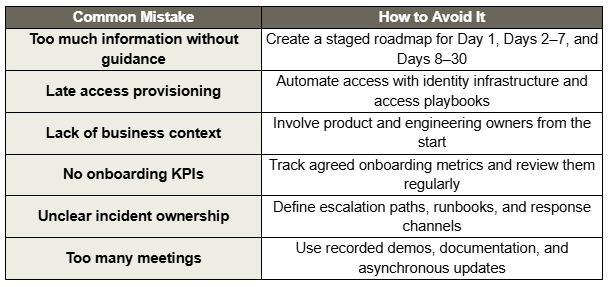
At Interfell, we have seen these mistakes repeated by companies without a structured onboarding process. That is why we support clients with proven methodology, SPK-powered talent evaluation, salary intelligence, and access to qualified professionals across LATAM.
Final Thoughts
For U.S. companies hiring remote DevOps engineers in LATAM, structured onboarding pays for itself through faster productivity, lower operational risk, and stronger retention (LinkedIn)
The most effective onboarding programs focus on three priorities:
- Access and security must be ready on day one.
- Mentorship and practical work should create early wins.
- KPIs and runbooks should provide visibility and consistency.
With these foundations, a remote hire can become a reliable, long-term DevOps contributor.
Interfell helps companies make this process successful with more than 10 years of experience across LATAM, Spain, and the U.S., access to more than 2.5 million professionals, the Smart Hiring Salary Guide 2027 for Latin America, and SPK, Simera’s AI-powered candidate evaluation tool.
Need experienced DevOps engineers in your time zone? Talk to Interfell about remote hiring, onboarding support, and salary benchmarking.
Interfell Related Articles
FAQs
1. Why is onboarding important for remote DevOps engineers?
Because DevOps engineers handle critical infrastructure, security, automation, and deployment workflows. A structured onboarding process helps them become productive faster while reducing operational risk.
2. What should be ready before the first day?
Documentation, hardware, SSO, VPN, IAM permissions, repository access, cloud access, security policies, and a 30/60/90-day plan should be ready before day one.
3. What is a good first task for a new DevOps engineer?
A good first task should be small but real, such as fixing a false alert, improving a deployment script, updating documentation, or reviewing a CI/CD pipeline.
4. How long should DevOps onboarding take?
The initial onboarding phase usually takes 30 days, but full integration often continues through a 60- or 90-day plan.
5. Why is LATAM a strong region for DevOps hiring?
LATAM offers strong technical talent, growing STEM pipelines, competitive costs, and time-zone alignment with U.S. companies.
6. What KPIs should companies track during onboarding?
Companies should track time to first deployment, access readiness, PR review activity, MTTR, clarity score, satisfaction, and retention at three and six months.
7. How can Interfell support remote DevOps onboarding?
Interfell supports companies through remote staffing, talent evaluation, salary intelligence, onboarding guidance, and access to qualified professionals across LATAM.
Brief Glossary
- CI/CD: Continuous integration and continuous delivery, a process for automating software builds, testing, and deployment.
- IaC: Infrastructure as Code, the practice of managing infrastructure through code instead of manual configuration.
- IAM: Identity and Access Management, a framework for managing user permissions and access.
- MTTR: Mean Time to Recovery, a metric that measures how quickly teams resolve incidents.
- Runbook: A documented procedure that explains how to handle technical operations or incidents.
- SLO: Service Level Objective, a measurable reliability target for a system or service.
- Least Privilege: A security principle that gives users only the access they need to perform their work.