

Summary
Hiring a machine learning engineer in Latin America helps U.S. companies access qualified AI talent, reduce hiring costs, and improve collaboration through overlapping time zones. This guide explains how to choose the right hiring model, evaluate ML candidates, onboard remote engineers, avoid common mistakes, and retain top talent, with support from Interfell’s regional expertise, salary intelligence, and SPK evaluation tool.
Table of Contents
- Introduction
- Benefits of Hiring ML Talent in Latin America
- Hiring Models and Legal Compliance
- How to Identify and Evaluate ML Candidates?
- Recommended Interview Process
- Effective Remote Onboarding
- Retention and Professional Development
- Common Mistakes and How to Avoid Them
- Why Choose Interfell?
- Quick Checklist Before Making an Offer
- Final Thoughts
- FAQ: Hiring Machine Learning Engineers in Latin America
- Quick Glossary
Introduction
Hiring a machine learning engineer in Latin America is a strategic way for U.S. companies to access strong AI talent, reduce hiring costs, and improve time-zone collaboration.
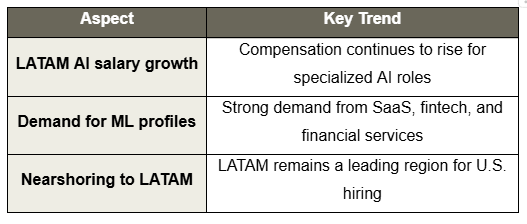
Latin America has a growing pool of engineers with experience in Python, TensorFlow, PyTorch, data science, model deployment, and MLOps. For SaaS, fintech, AI, and digital product companies, the region offers a strong balance of technical quality, cultural alignment, and cost efficiency.
With more than 10 years of experience across LATAM, Spain, and the United States, Interfell helps companies recruit, evaluate, and manage ML professionals through a database of more than 2.5 million candidates, the Smart Hiring Salary Guide 2026, and SPK (Simera Professional Key), an AI-powered evaluation tool developed by Simera.
Benefits of Hiring ML Talent in Latin America
Hiring ML talent in Latin America allows U.S. companies to build nearshore AI teams with strong technical capabilities and real-time collaboration (World Economic Forum)
Key benefits include:
- Time-zone overlap with U.S. teams
- Lower hiring costs compared with major U.S. tech markets
- Access to skilled engineers in Argentina, Colombia, Mexico, Chile, and Peru
- Strong foundations in software engineering, statistics, and data science
- Experience working with distributed and remote teams
For example, a SaaS startup in New York can hire ML engineers in Mexico or Colombia and collaborate during the same business day while reducing total hiring costs (RiseWorks).
Hiring Models and Legal Compliance
Choosing the right hiring model is essential for compliance, cost control, and long-term success.
Main Hiring Options
-
Direct Employee
Best for long-term roles, deeper integration, and stronger retention. The engineer is hired under local labor laws. -
Employer of Record (EOR)
An EOR manages payroll, taxes, benefits, and compliance. This is often the fastest way to hire internationally without opening a local entity. -
Freelance Contractor or B2B Agreement
Useful for short-term projects or specialized ML work. Contracts should define scope, payment terms, intellectual property, confidentiality, and exclusivity. -
Local Subsidiary
Best for larger companies planning to build a long-term regional presence with more operational and tax control. -
Quick Legal Recommendations
Before making an offer, validate local labor obligations, define the worker relationship clearly, include IP and confidentiality clauses, review U.S. payment requirements, and offer benefits aligned with the local market.
How to Identify and Evaluate ML Candidates?
Start by defining the ideal candidate profile:
- Seniority level: junior, mid-level, senior, or lead
- Core stack: Python, TensorFlow, PyTorch, Scikit-learn, SQL
- Production experience: deployment, monitoring, observability
- MLOps knowledge: Docker, Kubernetes, CI/CD, model versioning
- Remote skills: documentation, async updates, and communication
Sourcing Channels
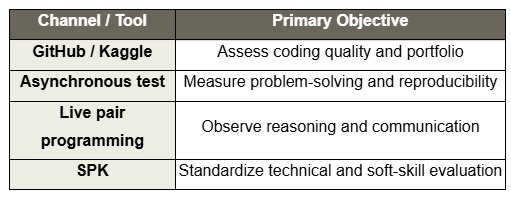
Use LinkedIn, GitHub, Kaggle, AI communities, universities, and specialized recruiting partners. Interfell also provides access to more than 2.5 million tech professionals filtered by stack, seniority, country, and ML experience (LinkedIn).
Recommended Technical Evaluation
A strong evaluation should measure practical ability, not just theory. Use:
- Production-oriented tests, such as deploying an inference API
- MLOps assessments covering pipelines, monitoring, and rollback plans
- Live pair programming to observe reasoning and communication
- Code reviews to evaluate maintainability
- SPK to standardize technical and soft-skill assessments
Recommended Interview Process
A structured process improves hiring quality and candidate experience.
Initial Screening — 30 minutes
Review background, project experience, salary expectations, English level, availability, and time-zone compatibility.
Asynchronous Technical Test — 3 to 7 days
Assign a realistic ML challenge with clear deliverables, reproducible code, documentation, and results.
Technical Interview — 60 to 90 minutes
Discuss the solution, model design, architecture choices, trade-offs, testing, deployment, and MLOps knowledge.
Cultural Interview — 45 to 60 minutes
Evaluate communication, remote work habits, feedback management, ownership, and company fit.
Pilot Project — Optional
A paid 1–2 week pilot can validate technical ability and collaboration before a long-term commitment.
Effective Remote Onboarding
Good onboarding helps ML engineers contribute faster and stay engaged.
Before day one, prepare repository access, development tools, testing environments, architecture documentation, MLOps standards, security policies, and sample datasets.
Suggested 30/60/90-Day Plan
First 30 Days
Understand architecture, data pipelines, workflows, documentation, and internal standards. Deliver small fixes or model improvements.
First 60 Days
Take partial ownership of an ML workflow and contribute to measurable model or pipeline improvements.
First 90 Days
Participate in new ML feature design, propose optimizations, and contribute to production-level improvements.
Retention and Professional Development
Demand for experienced ML professionals continues to grow, especially for engineers who can move models from experimentation to production (Qubit-Labs).
To retain machine learning engineers in Latin America, companies should offer:
- Competitive compensation by country and seniority
- Clear technical and leadership career paths
- Training in AI frameworks, MLOps, and cloud tools
- Ownership of meaningful projects
- Consistent feedback and recognition
- Strong human connection through team rituals or off-sites
Common Mistakes and How to Avoid Them
1. Over-relying on theoretical interviews
Prioritize practical deliverables, production experience, and real-world problem-solving.
2. Incorrect worker classification
Misclassifying employees as contractors can create legal and tax risks. Work with an EOR or local legal advisor.
3. Weak onboarding
Prepare documentation, access, mentorship, and a 30/60/90-day plan before the engineer starts.
4. Poor communication expectations
Define shared working hours, communication channels, meeting cadence, documentation standards, and response times early.
Why Choose Interfell?
Interfell helps U.S. companies hire and manage ML engineers across Latin America and Spain.
With more than 10 years of regional experience, Interfell offers:
- Access to more than 2.5 million professionals.
- Candidate filtering by stack, seniority, country, and work model
- Salary intelligence through the Smart Hiring Salary Guide for 2026
- AI-powered evaluation through SPK (Simera Professional Key)
- Support for direct hiring, EOR, freelance contracts, and subsidiaries
- End-to-end recruitment support from sourcing to onboarding
Looking to scale your AI team faster? Explore Interfell’s LATAM machine learning talent network.
Quick Checklist Before Making an Offer
Before hiring a machine learning engineer in Latin America, confirm that you have:
- Benchmarked salary expectations by country
- Selected the right hiring model
- Reviewed legal and tax risks
- Completed technical and cultural interviews
- Documented stakeholder feedback
- Prepared a 30/60/90-day onboarding plan
- Assigned a mentor or technical lead
- Prepared repository, tool, and documentation access
- Defined compensation, benefits, bonuses, and remote work policies
- Confirmed communication expectations and working hours
Final Thoughts
Hiring machine learning engineers in Latin America helps U.S. companies expand AI capabilities, reduce costs, and collaborate across similar time zones.
The key is to combine a clear hiring strategy, practical technical evaluation, compliant contracts, structured onboarding, and long-term retention planning.
Ready to hire production-ready ML engineers in Latin America? Talk to Interfell about sourcing, evaluation, onboarding, and long-term team support.
Interfell Related Articles
-
Complete Guide for US Companies Seeking Remote Developers in LATAM
-
Nearshoring versus Offshoring: What US Companies need to know?
FAQ: Hiring Machine Learning Engineers in Latin America
1. How do you hire a machine learning engineer in Latin America?
Define the role, choose a compliant hiring model, source candidates through specialized channels, evaluate technical and MLOps skills, and prepare structured onboarding.
2. Which LATAM countries have strong ML talent?
Argentina, Colombia, Mexico, Chile, and Peru are strong sources of talent in machine learning, data science, and software engineering.
3. What skills should an ML engineer have?
A strong ML engineer should know Python, TensorFlow or PyTorch, data pipelines, model deployment, testing, monitoring, and MLOps tools.
4. What is the best hiring model for U.S. companies?
For many U.S. companies, an Employer of Record is the fastest compliant option. Direct hiring, freelance contracts, and subsidiaries may also work depending on goals.
5. How much does it cost to hire ML engineers in Latin America?
Costs vary by country, seniority, and hiring model, but Latin America often offers more cost-efficient hiring compared with major U.S. tech markets.
6. How can companies evaluate remote ML engineers?
Use practical tests, GitHub or Kaggle reviews, pair programming, MLOps assessments, and structured tools like SPK to evaluate both technical and soft skills.
7. How can Interfell help?
Interfell helps companies source, evaluate, hire, and onboard ML engineers using regional expertise, salary data, SPK assessments, and a database of more than 2.5 million professionals.
Quick Glossary
- Machine Learning Engineer: A technical professional who builds, trains, deploys, and maintains machine learning models.
- MLOps: The practice of managing machine learning models in production through automation, monitoring, testing, and deployment workflows.
- Nearshore Hiring: Hiring talent in nearby regions with similar or overlapping time zones.
- Employer of Record: A third-party provider that manages payroll, taxes, benefits, and local compliance for international employees.
- Asynchronous Test: A technical assessment completed independently by the candidate within a defined timeframe.
- Model Deployment: The process of moving a machine learning model into a production environment where users or systems can access it.
- Talent Database: A structured pool of candidates filtered by skills, experience, location, and availability.