


…and Why It’s a Strategic Move
Summary
Hiring software developers in Latin America (LATAM) in 2026 has shifted from a “cost play” to a strategic growth move for U.S. startups and scaleups. The region offers a rare combination of strong technical talent, overlapping time zones for real-time collaboration, high English proficiency, and competitive salary benchmarks—often delivering 30–50% cost savings without sacrificing quality.
Want to see real profiles? Browse software engineers in Latin America with video on Interfell's talent search.
This guide breaks down why LATAM is an advantage (speed, collaboration, and depth of talent), and how to hire successfully with a clear step-by-step process: define the role, choose the right hiring model (direct hiring, Employer of Record, or nearshore staffing partner), evaluate both technical and communication skills, and offer locally benchmarked compensation while prioritizing retention. It also covers common pitfalls like compliance complexity, competition for senior talent, and long hiring cycles—plus practical ways to solve them.
If your company needs to scale engineering quickly, improve cost efficiency, and maintain tight collaboration with U.S. teams, LATAM can be a powerful nearshore strategy—and with the right process (or partner), a true growth accelerator.
Table of Contents
-
Introduction
-
Why Hire Software Developers in LATAM?
-
How to Hire Software Developers in LATAM (Step-by-Step)
-
Average Developer Salaries in LATAM (2026 Overview)
-
3 Common Challenges (And How to Solve Them)
-
Is Hiring in LATAM Right for Your Company?
-
Final Thoughts
-
Thinking About Expanding Your Engineering Team?
-
FAQs
Introduction
Hiring software developers in LATAM is no longer just a cost-saving tactic — it’s a strategic growth decision.
In 2026, startups and scaleups across the U.S. are turning to Latin America to build high-performing engineering teams without sacrificing quality, speed, or collaboration.
Countries like Mexico, Brazil, Argentina, Colombia, Chile, and Venezuela offer a powerful combination of:
-
Strong technical expertise
- U.S. time zone alignment
- High English proficiency
- Competitive salary benchmarks
- Remote-ready talent
Why Hire Software Developers in LATAM?
1. Real-Time Collaboration with U.S. Teams
One of the biggest advantages of nearshore software development in Latin America is time zone alignment.
Unlike offshore teams in Asia or Eastern Europe, most LATAM countries operate within or close to U.S. working hours. This enables:
- Seamless daily standups
- Faster sprint cycles
- Immediate bug resolution
- Strong collaboration between product, design, and engineering
For agile teams, this real-time overlap significantly increases productivity and reduces communication friction.
2. Competitive Costs Without Compromising Quality
Companies that hire software developers in LATAM typically reduce engineering costs by 30–50% compared to U.S.-based salaries.
But lower cost does not mean lower quality.
Many LATAM software developers:
- Have experience working with U.S. startups and enterprises
- Are fluent in English
- Contribute to open-source projects
- Work with modern stacks like React, Node.js, Python, Java, .NET, AWS, and DevOps tools.
This makes Latin America one of the strongest regions for building remote engineering teams efficiently and sustainably.
3. A Rapidly Growing Tech Talent Pool
Over the last decade, LATAM’s tech ecosystem has expanded significantly.
Countries such as:
- Brazil (the largest tech market in the region)
- Mexico (strong U.S. overlap and growing startup scene)
- Argentina (high English proficiency and senior talent)
- Colombia (fast-growing digital ecosystem)
- Chile (stable infrastructure and innovation hubs)
- Venezuela (highly skilled remote engineering talent)
have invested heavily in STEM education, digital infrastructure, and global workforce integration.
The result: a deep pool of remote-ready engineers with international experience.
How to Hire Software Developers in LATAM (Step-by-Step)
A structured hiring strategy is essential when scaling internationally.
Step 1: Clearly Define the Role
Before sourcing candidates, define:
- Required tech stack
- Seniority level (junior, mid-level, senior, tech lead)
- English proficiency expectations
- Core responsibilities and KPIs
- Collaboration model (async vs real-time)
Clarity at this stage significantly reduces time-to-hire.
Step 2: Choose the Right Hiring Model
There are three primary ways to hire developers in Latin America:
1. Direct Hiring (Local Entity Setup)
You establish a legal entity in-country and hire directly.
Best for long-term regional expansion.
2. Employer of Record (EOR)
An EOR legally employs the developer on your behalf, managing payroll, compliance, taxes, and benefits.
Ideal for companies hiring internationally without opening a local entity.
3. Nearshore Staffing Partner
A specialized partner sources, vets, and presents pre-qualified LATAM talent while supporting compliance and onboarding.
Step 3: Evaluate Technical and Communication Skills
An effective hiring process should include:
- Technical assessments (live coding or take-home tests)
- System design interviews for senior engineers
- English communication screening
- Soft skills and cultural alignment evaluation
In distributed teams, autonomy, ownership, and communication are just as important as coding ability.
Step 4: Offer Competitive Compensation
While LATAM developer salaries are lower than in the U.S., top talent is highly competitive.
Typical 2026 annual salary ranges:
- Junior Developer: $20,000 – $35,000
- Mid-Level Developer: $35,000 – $55,000
- Senior Developer: $55,000 – $85,000
To attract and retain top engineers:
- Benchmark salaries locally
- Offer growth opportunities
- Provide long-term stability
- Include remote flexibility and learning budgets
Retention strategy is just as important as hiring speed.
Average Developer Salaries in LATAM (2026 Overview)
Salaries vary by country and experience level, but general ranges include:
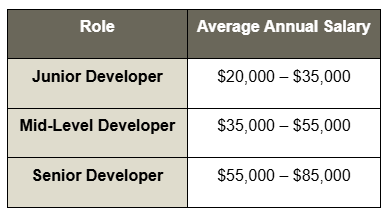
Compared to U.S. salary benchmarks, these ranges allow companies to scale engineering capacity more efficiently.
3 Common Challenges (And How to Solve Them)
1. Legal and Compliance Complexity
Solution: Use an Employer of Record (EOR) or trusted staffing partner.
2. Increasing Competition for Senior Talent
Solution: Move quickly and present a compelling value proposition.
3. Long Hiring Cycles
Solution: Access pre-vetted developer networks instead of starting from scratch.
Is Hiring in LATAM Right for Your Company?
Hiring software developers in LATAM makes sense if you:
- Need to scale your engineering team quickly
- Want to optimize development costs
- Require real-time collaboration with U.S. teams
- We are building a long-term remote-first organization
For SaaS startups, fintech companies, AI startups, and product-driven organizations, LATAM offers one of the strongest nearshore talent advantages available today.
Final Thoughts
The global workforce has changed.
Companies that scale fastest in 2026 are those that build distributed, high-performance teams across borders.
Hiring software developers in LATAM gives you:
- Cost efficiency
- Cultural alignment
- Real-time collaboration
- Access to top-tier engineering talent
It’s not outsourcing.
It’s smart global scaling.
Thinking About Expanding Your Engineering Team?
If you’re exploring how to hire pre-vetted software developers in LATAM — without compliance headaches or long hiring cycles — it may be worth speaking with a nearshore recruitment specialist.
The right partner can dramatically reduce time-to-hire while ensuring quality and retention.
FAQs
1. Why hire software developers in LATAM instead of offshore regions?
Hiring software developers in LATAM offers strong U.S. time-zone alignment, competitive costs, and high English proficiency, enabling real-time collaboration and faster development cycles compared to offshore regions.
2. How much does it cost to hire a developer in Latin America in 2026?
In 2026, average annual salaries range from $20,000–$35,000 for junior developers, $35,000–$55,000 for mid-level, and $55,000–$85,000 for senior engineers, depending on country and expertise.
3. What is the best country to hire developers in LATAM?
Brazil, Mexico, Argentina, and Colombia are among the top markets due to talent availability, tech ecosystem maturity, and strong remote-work readiness.
4. Is hiring developers in LATAM cheaper than in the U.S.?
Yes. Companies typically reduce engineering costs by 30–50% compared to U.S.-based salaries while maintaining high technical standards.
5. Do LATAM software developers speak English?
Many LATAM developers working with international companies have strong English proficiency, especially in Argentina, Mexico, Colombia, and Brazil.
6. What is an Employer of Record (EOR) in LATAM?
An Employer of Record (EOR) is a third-party organization that legally employs developers on your behalf, managing payroll, taxes, compliance, and benefits in the local country.
7. How long does it take to hire a software developer in LATAM?
Depending on the hiring model, it can take 2–6 weeks. Working with a nearshore staffing partner can significantly reduce time-to-hire.