


Summary
Hiring AI trainers in Latin America (LATAM) is a smart strategy for companies scaling AI products in 2026. LATAM offers strong technical talent, overlapping U.S. time zones, and meaningful cost savings—without sacrificing quality when you implement clear rubrics and QA workflows.
Want to see real profiles? Browse AI and machine learning engineers in Latin America with video and salary ranges on Interfell's talent search.
This guide explains what AI trainers do, why LATAM is an ideal nearshore destination, the key skills to evaluate, salary expectations by seniority, and a step-by-step hiring process (including onboarding and calibration). It also outlines when to hire freelancers vs. full-time remote employees vs. dedicated nearshore teams through a partner like Interfell.
Table of Contents
- Introduction
- What Is an AI Trainer?
- AI Trainer vs. Data Annotator vs. LLM Evaluator (Quick Clarification)
- Why Hire AI Trainers in LATAM?
- Key Skills to Look for in an AI Trainer
- AI Trainer Salary Expectations in LATAM (2026)
- How to Hire AI Trainers in LATAM (Step-by-Step)?
- Why Companies Partner With Interfell to Hire AI Talent?
- Build Your AI Team With LATAM Talent
- Interfell Related Articles
- FAQs: About Hiring AI Trainers in LATAM
Introduction
Artificial intelligence systems are only as strong as the data and human feedback used to train them. Behind every high-performing model, there’s a team of skilled AI trainers labeling data, refining outputs, and enforcing consistent quality.
For companies scaling AI products, hiring the right AI trainers is critical. And increasingly, businesses are turning to Latin America (LATAM) for nearshore AI talent that’s cost-effective, highly skilled, and aligned with U.S. working hours.
In this guide, you’ll learn what AI trainers do, why LATAM is a strategic hiring destination, AI trainer salary expectations in LATAM, and a step-by-step process to hire the right professionals for your team. (ibm.com)
What Is an AI Trainer?
An AI trainer is a professional who improves machine learning models by providing structured data, annotations, feedback, and human-in-the-loop signals. (ibm.com)
Depending on your project, AI trainers may:
- Perform data labeling for text, images, audio, or video
- Handle data annotation and quality control
- Fine-tune LLM outputs using human feedback
- Create prompt variations for generative AI models (prompt engineering)
- Conduct an LLM evaluation to measure accuracy and usefulness
- Evaluate model performance and reduce bias (bias evaluation)
- Train AI systems using RLHF (Reinforcement Learning from Human Feedback)
AI trainers play a crucial role in ensuring AI systems are accurate, safe, and aligned with real user expectations.
AI Trainer vs. Data Annotator vs. LLM Evaluator (Quick Clarification)
- Data annotators focus primarily on labeling and tagging datasets.
- AI trainers often combine annotation with QA, guidelines, and consistency checks.
- LLM evaluators/trainers specialize in ranking model outputs, applying rubrics, and supporting workflows like RLHF.
Why Hire AI Trainers in LATAM?
Latin America has become a top nearshore destination for AI and tech hiring. Here’s why.
1. Cost Efficiency Without Quality Trade-Offs
Hiring LATAM AI trainers can reduce labor costs by roughly 30–60% compared to U.S.-based hiring, while maintaining strong quality standards—especially when you implement clear QA processes and rubrics. (interfell.com)
2. Strong STEM Education
Countries like Mexico, Colombia, Argentina, and Brazil produce large numbers of engineering and data-focused graduates each year, building a deep talent pool for AI-adjacent roles. (report.revelo.com)
3. Time Zone Alignment With the U.S.
Most LATAM countries share overlapping business hours with the U.S., enabling real-time collaboration and faster iteration on labeling, evaluation, and QA.
4. English Proficiency
Many AI trainers and data professionals in LATAM have strong English communication skills—especially candidates with experience working with U.S. teams and international clients.
5. Cultural Compatibility and Retention
LATAM teams often integrate smoothly into the North American work culture, which supports long-term retention, consistent delivery, and fewer coordination gaps.
Key Skills to Look for in an AI Trainer
When hiring AI trainers in LATAM, prioritize candidates with the right mix of technical ability and consistency-focused soft skills.
Technical Skills
Look for experience with:
- Data annotation tools (e.g., Labelbox, Prodigy, Scale AI workflows)
- Python basics (helpful for structured tasks and validation)
- Familiarity with NLP or computer vision workflows
- LLM evaluation (rubrics, ranking outputs, edge-case handling)
- Understanding of bias detection and mitigation
- Dataset review practices and quality measurement
Soft Skills
Strong AI trainers tend to share:
- Analytical thinking
- Attention to detail
- Strong written communication
- Consistency and a quality-control mindset
- Comfort with repetitive tasks and long-running projects
High-Value Skills for Advanced LLM Trainer Roles
For more advanced roles, prioritize:
- RLHF experience (ranking, preference labeling, feedback loops)
- Prompt engineering and prompt variation creation
- Dataset curation and taxonomy design
- Rubric design and evaluator calibration methods
AI Trainer Salary Expectations in LATAM (2026)
Salaries vary by country, seniority, English proficiency, and specialization (especially in LLM evaluation and RLHF).
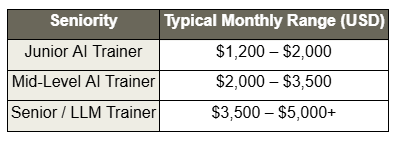
Compared to U.S.-based AI trainers, companies can achieve substantial cost savings while maintaining performance—especially with a well-defined QA process.
What Impacts Salary Most?
- Country and local market demand
- English communication level
- Domain specialization (healthcare, finance, legal, etc.)
- LLM-specific skillsets (evaluation, rubric design, RLHF)
- Proven QA ownership (leading review loops and calibrations)
How to Hire AI Trainers in LATAM (Step-by-Step)?
To hire AI trainers in LATAM, define your training scope (annotation, LLM evaluation, RLHF), run a paid skills test, set quality metrics, implement QA review cycles, and choose a hiring model (direct, freelance, or partner) to scale reliably.
Step 1: Define the Scope
Start by clarifying what you need AI trainers to do. For example:
- Data annotation and dataset labeling
- LLM fine-tuning support and response ranking
- Bias evaluation and safety checks
- Prompt testing and prompt optimization
- Ongoing model monitoring and regression testing
The clearer the scope, the easier it is to hire for outcomes instead of vague skills.
Step 2: Assess Technical Proficiency
AI training roles need consistent judgment. Include practical tests such as:
- Annotation sample tasks (with edge cases)
- LLM evaluation exercises using a rubric
- Prompt rewrite or variation challenges
- Written communication assessments (clarity + reasoning)
Tip: Use paid trial tasks to reflect real work and reduce hiring risk.
Step 3: Prioritize Quality Control
AI training requires repeatable consistency. Build quality into the workflow using:
- Clear evaluation rubrics and labeling guidelines
- QA review cycles (peer review + lead review)
- Gold-standard tasks (known answers)
- Performance metrics: accuracy, agreement rate, rework rate, throughput
Step 4: Choose the Right Hiring Model
You can hire AI trainers in LATAM through multiple models:
- Freelancers (fast to start, flexible capacity)
- In-house remote employees (better retention and ownership)
- Dedicated nearshore teams via a partner (fast scaling + compliance support)
Working with a nearshore partner can simplify sourcing, vetting, payroll, contracts, and local compliance—especially if you’re hiring across multiple LATAM countries.
Step 5: Onboard With Rubrics + Calibration
Most teams lose quality after hiring because onboarding is too light. To avoid inconsistency:
- Provide clear guidelines and edge-case examples
- Run weekly calibration sessions to align judgment across trainers
- Refresh rubrics when the model or product changes
- Keep a shared “decision log” for tricky cases and exceptions
This step is essential for long-term annotation quality control and stable model improvements.
Why Companies Partner With Interfell to Hire AI Talent?
At Interfell, we help U.S. companies build high-performing remote teams in Latin America.
We help you:
- Pre-vet AI and data professionals
- Ensure English proficiency and cultural fit
- Handle recruitment, contracts, and compliance
- Match you with talent aligned to your technical needs and workflows
Whether you need one AI trainer or a full data annotation team, Interfell helps you scale quickly and cost-effectively—without sacrificing quality.
Mid-article CTA: Want to hire vetted LATAM AI trainers faster? Contact Interfell to see curated profiles aligned to your AI training workflow.
Build Your AI Team With LATAM Talent
Demand for AI trainers continues to grow as companies expand AI-powered products. Hiring in LATAM gives you access to skilled professionals, cost efficiency, and time zone alignment—without slowing down iteration cycles.
If you're ready to scale your AI initiatives, Interfell can help you quickly and efficiently hire vetted AI trainers in Latin America.
Ready to hire AI trainers in LATAM?
Contact Interfell today and build your nearshore AI team.
Interfell Related Articles
FAQs: About Hiring AI Trainers in LATAM
1. How long does it take to hire an AI trainer?
With a specialized partner, hiring often takes 2–4 weeks, depending on role complexity, seniority, and required LLM-specific skills.
2. What’s the difference between AI trainers and data annotators?
Data annotators typically focus on labeling tasks. AI trainers often add QA ownership, rubric-based evaluation, and feedback loops to improve models—especially in LLM workflows.
3. Do AI trainers need to be engineers?
Not always. Many roles focus on structured annotation and evaluation rather than building models. For advanced work (like RLHF or automation), technical skills become more important.
4. Which skills matter most when hiring LATAM AI trainers for LLMs?
Strong written English, attention to detail, rubric-based judgment, experience with LLM evaluation, and familiarity with prompt variations. For advanced roles, RLHF and dataset curation are major pluses.
5. How should I test candidates before hiring?
Use a paid practical test: a small annotation task, an LLM evaluation/ranking task using a rubric, and a short written reasoning assessment to confirm clarity and consistency.
6. Is LATAM talent reliable for long-term projects?
Yes. Many companies report strong retention and performance when hiring nearshore professionals—especially when expectations, QA, and career paths are clear.
7. What are typical salary ranges for AI trainers in LATAM in 2026?
Ranges often fall around: Junior $1,200–$2,000/month, Mid $2,000–$3,500/month, Senior/LLM Trainer $3,500–$5,000+/month, depending on specialization and country.