


Summary
U.S. companies are increasingly hiring remote developers in Latin America to access specialized technical talent, reduce hiring costs, and improve real-time collaboration with distributed teams. LATAM offers strong time zone alignment, growing English proficiency, cultural affinity, and expanding expertise in modern software stacks. This guide explains the main benefits of nearshore hiring, compares leading Latin American markets, outlines salary benchmarks, and shows how Interfell supports companies through role definition, AI-powered candidate screening, technical evaluation, compliance, onboarding, and retention support.
Want to see real profiles? Browse software engineers in Latin America with video on Interfell's talent search.
Table of Contents
- Introduction
- Why U.S. Companies Are Hiring Remote Developers in Latin America?
- Best Countries in Latin America for Hiring Developers
- LATAM Developer Salary Benchmarks by Country
- How Interfell Helps: Methodology and Tools?
- How Interfell Helps U.S. Companies Hire LATAM Developers?
- Common Challenges and How to Mitigate Them?
- Final Thoughts
- FAQs
- Glossary
Introduction
For U.S. companies, hiring software developers has become more competitive, costly, and slow. Demand keeps rising, while teams face longer hiring cycles, higher salary expectations, and pressure to scale without increasing burn rate.
That is why more U.S. companies are hiring remote developers in Latin America. The region offers technical skills, competitive salary ranges, cultural affinity, and real-time collaboration with U.S. teams (LinkedIn)
This guide explains why Latin America has become a strategic region for nearshore software development, which countries offer strong developer talent pools, and how Interfell helps companies hire, evaluate, onboard, and retain LATAM developers with less risk.
Interfell brings 12+ years of hiring experience across LATAM, Spain, and the U.S. Its approach combines recruiters, technical evaluators, the Smart Hiring Salary Guide 2027, and SPK (Simera Professional Key), an AI tool developed by partner Simera to assess technical skills, soft skills, and cultural fit.
Why U.S. Companies Are Hiring Remote Developers in Latin America?
Hiring in Latin America is no longer only about cost savings. It helps U.S. companies access skilled engineering talent, hire faster, and collaborate during the same business day (Technavio).
1. Lower Development Costs
One of the main reasons companies choose remote developers in Latin America is cost efficiency. Average salary ranges for IT professionals in many LATAM markets are typically lower than U.S. averages, including for senior profiles.
Still, the goal should not be to hire the cheapest candidate. Strong results come from competitive compensation based on role, seniority, country, specialization, and retention risk.
Interfell’s Smart Hiring Salary Guide 2027 helps companies compare LATAM salary expectations and define realistic budgets for frontend, backend, DevOps, QA, data, and leadership roles.
2. Better Time Zone Alignment
Latin America offers a major operational advantage for U.S. companies: time zone overlap.
Most LATAM countries are within a few hours of U.S. time zones, making it easier for developers to join standups, planning, code reviews, stakeholder meetings, and production support.
This makes LATAM especially attractive for agile teams that need real-time collaboration instead of delayed communication across distant time zones.
3. Cultural and Skills-Based Advantages
- Stronger cultural affinity with the U.S. market: Exposure to U.S. products, services, and business practices helps many Latin American professionals align with U.S. workplace expectations.
- Growing English proficiency: Several LATAM markets continue improving English proficiency, creating more talent for remote, English-speaking teams. SPK supports this by evaluating communication in technical contexts (StackOverflow).
- Continuous upskilling: Bootcamps, universities, and tech communities across LATAM have adapted to modern stacks such as JavaScript, TypeScript, cloud computing, and DevOps (StackOverflow)
Best Countries in Latin America for Hiring Developers
There is no single “best” country for every hiring need. The right market depends on role, budget, stack, seniority, time zone, and speed to hire.
Interfell manages hundreds of thousands of validated IT professionals across Latin America. The overview below helps U.S. companies design a smarter nearshore strategy.
LATAM Developer Salary Benchmarks by Country
Salary expectations vary by role, seniority, specialization, English level, and country. Interfell’s Smart Hiring Salary Guide 2027 helps companies compare junior, mid-level, and senior profiles before making offers.
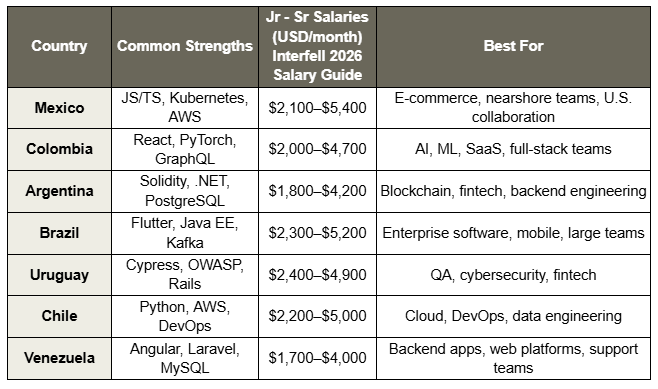
These benchmarks help companies avoid underpricing roles and losing strong candidates, or overpaying without understanding local market expectations.
How Interfell Helps: Methodology and Tools?
Interfell provides a clear methodology to reduce friction when hiring remote talent in Latin America.
1. Strategic Role Definition
Interfell defines the role, stack, seniority, and salary range with each company. The Salary Guide helps keep offers competitive without oversizing budgets.
2. AI-Powered Search and Preselection
SPK, developed with Simera, processes profile data, assessments, code activity, and responses, then ranks candidates by technical skills, soft skills, and cultural fit.
3. Structured Technical and Cultural Evaluation
Top candidates move to tech-led interviews, with live coding or system design when needed. SPK consolidates results into an overall score for consistent comparisons.
4. Negotiation, Hiring, and Compliance
Using Salary Guide data, Interfell helps design sustainable offers and, when needed, works with EOR partners and payment solutions to support local compliance.
5. Onboarding and Ongoing Support
Interfell supports onboarding, remote management practices, and early performance measurement so companies can confirm fit in the first months.
How Interfell Helps U.S. Companies Hire LATAM Developers?
Interfell reduces friction and risk across the full hiring process, from role definition to onboarding.
1. Role Definition and Salary Benchmarking
Interfell defines the role, stack, seniority, and salary range, supported by the Smart Hiring Salary Guide 2027.
2. AI-Powered Candidate Screening With SPK
SPK evaluates candidates consistently by processing assessments, profile data, code activity, and responses to rank role fit.
This helps companies identify stronger candidates earlier and reduce unqualified interviews.
3. Technical and Cultural Evaluation
Top-ranked candidates move through technical interviews. Depending on the role, evaluations may include live coding, system design, architecture discussions, or practical assessments.
SPK consolidates results into an overall evaluation, helping companies compare candidates more objectively.
4. Hiring, Compliance, and Payment Support
Interfell designs offers using local salary data and works with EOR partners or payment platforms to support compliant hiring across Latin America.
5. Onboarding and Ongoing Support
Interfell supports onboarding with best practices for remote management, agile collaboration, documentation, performance tracking, and retention.
This support helps turn successful hires into long-term contributors.
Common Challenges and How to Mitigate Them?
Hiring remote developers in Latin America offers major advantages, but companies should anticipate a few challenges.
- Managing cultural and communication differences: Cultural affinity with the U.S. is strong, but feedback styles may vary. SPK and Interfell help identify work styles early and align expectations.
- Navigating compliance across multiple countries: Each country has its own legal, tax, and employment rules. Interfell works with specialized partners to reduce risk and simplify contracts.
- Retaining talent in dynamic markets: Demand for LATAM IT professionals is increasing, so retention requires competitive compensation, learning opportunities, and an inclusive culture.
Final Thoughts
Nearshoring to Latin America is no longer just a cost-saving tactic. It is a driver of innovation and growth. Mexico, Colombia, Argentina, Brazil, Uruguay, Chile, and Venezuela offer specialized talent ready for global teams.
Interfell combines market experience, its LATAM Salary Guide, and SPK’s AI evaluation technology by Simera to to reduce complexity and risk across hiring.
LATAM teams can accelerate feature deployment, reduce burn rate, and help companies compete globally. The question is how quickly nearshoring can be executed well.
Schedule your consultation with Interfell today and lead the remote tech talent revolution.
Interfell Related Articles
-
Why are US companies now hiring Full-Stack Developers in LATAM?
-
Nearshoring versus Offshoring: What US Companies need to know?
FAQs
1. Why are U.S. companies hiring remote developers in Latin America?
Because Latin America offers skilled software developers, competitive salary ranges, strong time zone overlap, and better real-time collaboration than many distant offshore markets.
2. Is hiring LATAM developers only about reducing costs?
No. Cost efficiency is important, but companies also value technical expertise, cultural alignment, faster hiring, and the ability to build scalable nearshore engineering teams.
3. Which LATAM countries are strong for hiring developers?
Mexico, Colombia, Argentina, Brazil, Uruguay, Chile, and Venezuela are strong markets, each offering different strengths depending on stack, seniority, budget, and business needs.
4. What roles can U.S. companies hire in LATAM?
Companies can hire frontend developers, backend developers, full-stack developers, DevOps engineers, QA specialists, data engineers, cloud specialists, and technical leads.
5. How does Interfell evaluate remote developers?
Interfell combines expert recruitment, technical interviews, salary benchmarking, and SPK, an AI-powered tool that analyzes technical skills, soft skills, communication, and cultural fit.
6. How does Interfell support compliance when hiring in LATAM?
Interfell supports compliant hiring through regional experience, Employer of Record partners, and international payment solutions when required by the hiring model.
7. How can companies retain LATAM tech talent?
Retention improves with competitive compensation, clear growth opportunities, strong onboarding, inclusive remote culture, consistent feedback, and well-managed distributed collaboration.
Glossary
-
Nearshoring: Hiring talent or outsourcing services in nearby countries, usually with similar time zones and easier collaboration.
-
Time Zone Overlap: Shared working hours between teams in different locations, which enables faster communication, meetings, reviews, and support.
-
Salary Benchmarking: The process of comparing compensation expectations by role, seniority, country, skills, and market demand.
-
Employer of Record (EOR): A third-party provider that helps companies hire workers in another country while managing local employment, payroll, and compliance requirements.
-
Technical Evaluation: A structured assessment of a candidate’s programming knowledge, architecture skills, problem-solving ability, and practical experience.
-
Cultural Fit: The degree to which a candidate’s communication style, work habits, expectations, and values align with a company’s remote team culture.
-
Retention Risk: The likelihood that a hired professional may leave due to compensation gaps, limited growth opportunities, weak onboarding, or market competition.