


Summary
Hiring a data engineer can help a company scale operations, automate workflows, improve analytics, and support AI initiatives. The wrong hire, however, can create unstable pipelines, inconsistent data, security issues, uncontrolled cloud costs, and weak documentation.
Want to see real profiles? Browse data engineers and analysts in Latin America with video and salary ranges on Interfell's talent search.
Companies should therefore evaluate more than Python, SQL, and cloud knowledge. They must also assess production experience, system design, incident response, communication, security, and ownership.
This guide explains how to define the role, compare salaries across Latin America, evaluate candidates, structure the hiring process, and safely onboard a data engineer.
Table of Contents
-
Introduction
-
The Data Engineering Talent Market in LATAM
-
Data Engineer Salary Benchmarks for 2026
-
Additional Data by Country (in Local Currency)
-
How to Build a Stronger Data Engineering Hiring Strategy
-
How to Define the Data Engineer Role Correctly
-
A Five-Stage Data Engineer Hiring Process
-
How to Onboard a Data Engineer Without Creating Unnecessary Risk
-
Common Data Engineer Hiring Mistakes
-
Key Market Insights
-
What Your Company Gains From a Better Hiring Process
-
Final thoughts
-
Interfell Related Articles
-
FAQs
-
Quick Glossary
Introduction
Companies depend on data pipelines for reporting, automation, customer analytics, machine learning, and AI.
Data engineers connect sources, manage pipelines, enforce quality standards, and keep information moving reliably. A poor hire can cause pipeline failures, inconsistent data, excessive cloud costs, incorrect permissions, weak documentation, slow incident response, and delayed projects.
The hiring process must determine whether the candidate can operate production systems, resolve incidents, protect data, document decisions, and communicate with technical and business teams.
The LATAM Data Engineering Market in LATAM
Demand for data engineers has grown as companies adopt cloud platforms, automation, AI, and data-driven strategies.
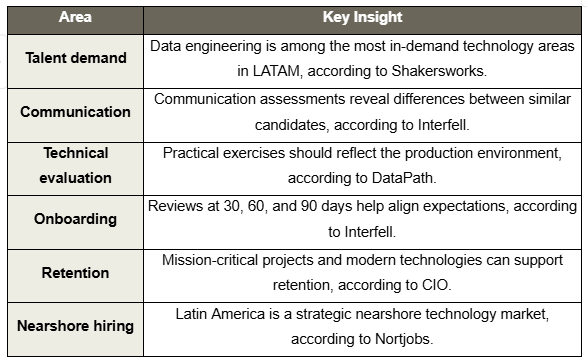
According to Shakers, data engineering is among the most in-demand technology areas in Latin America, especially in Mexico, Colombia, Argentina, and Brazil (Shakers).
Experienced professionals now compare local opportunities with remote roles in the United States, Europe, and other markets. Companies must compete on salary, project quality, stability, growth, and ownership.
For U.S.-facing teams, candidates must also demonstrate reliability, security awareness, cost control, documentation, and clear communication.
Data Engineer Salary Benchmarks for 2026
Salaries vary by country, experience, English proficiency, specialization, contract type, and production responsibility.
Monthly Salaries in USD — 2026
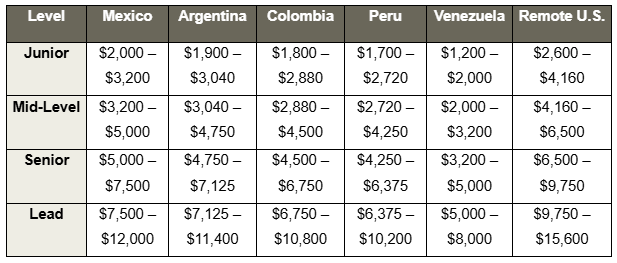
Source: Vacantes Digitales, 2026. Estimates for Venezuela were adjusted using regional benchmarks (Vacantes Digitales).
Additional Data by Country (in Local Currency)
- Mexico
Monthly salaries average just over MXN 42,500, ranging from MXN 24,000 for junior roles to MXN 70,000 for senior profiles (Vacantes Digitales).
- Argentina
Salaries are usually reported in USD, ranging from $1,200–$2,000 for junior roles to $3,500–$6,000+ for senior profiles (Datapath).
- Colombia
Data engineers earn an average of COP 5 million per month, with salaries ranging from COP 3 million to COP 10 million (Datademia).
- Peru
The average monthly salary is around PEN 5,800, while senior cloud or Databricks specialists may earn more than PEN 22,000 (Datapath).
- Venezuela
Monthly salaries range from $1,200–$2,000 for junior roles to $5,000–$8,000 for lead positions (Vacantes Digitales).
How to Build a Stronger Data Engineering Hiring Strategy
1. Align Compensation With the Market
Below-market offers in major LATAM markets are increasingly ineffective. Consider system complexity, production ownership, incident duties, English proficiency, and autonomy before setting compensation.
Interfell’s Smart Hiring Salary Guide 2027 allows companies to compare compensation by country, specialization, and seniority.
2. Position LATAM Talent Strategically
Latin America should not be presented only as a lower-cost option.
Its advantages include U.S. time-zone alignment, real-time collaboration, bilingual talent, remote experience, cloud expertise, and competitive compensation.
According to Vacantes Digitales, a senior data engineer in LATAM may earn $5,000 to $7,500 per month, compared with approximately $6,500 to $9,750 for a remote U.S. role (Vacantes Digitales).
The main benefit is access to qualified professionals who can collaborate with U.S. teams and work according to international standards.
3. Calculate the Total Cost
Salary is only part of the investment.
Companies should also consider benefits, equipment, software, cloud services, onboarding, administration, turnover, and incident costs.
A low offer may save money initially but become expensive if the employee leaves early or lacks the experience required for critical systems.
According to IDC, retaining data professionals can be as difficult as hiring them (CIO).
How to Define the Data Engineer Role Correctly
Before publishing the vacancy, define the problem the professional must solve.
Avoid generic descriptions such as “Data Engineer with Python, SQL, and AWS.”
According to Manatal, the description should clarify pipelines, integrations, migrations, critical systems, SLAs, costs, team structure, and first-90-day outcomes (Manatal).
Separate essential requirements from desirable skills.
Artema Consulting identifies a common mistake: expecting one person to cover data engineering, DevOps, AI engineering, analytics engineering, and cloud architecture (Artema).
A focused role attracts stronger candidates and improves evaluation accuracy.
A Five-Stage Data Engineer Hiring Process
1. Evaluate Communication
Ask the candidate to explain a previous project in writing or on video, covering the problem, architecture, decisions, challenges, and results.
Evaluate clarity, English proficiency, structure, and the ability to explain technical ideas to nontechnical stakeholders.
According to DataPath, someone who cannot explain why a pipeline failed may struggle during a real incident (Datapath).
2. Use a Practical Technical Assessment
Combine:
- Code review: Identify bugs, security risks, scalability issues, and maintenance problems.
- System design: Design a pipeline that considers reliability, monitoring, security, scalability, cost, and recovery. Nivelics recommends exercises that reflect the production environment (Nivelics).
- Focused exercise: Use a realistic task that can be completed within a reasonable time.
- Trade-off discussion: Ask why the candidate would choose one tool or architecture over another.
3. Run a Structured Interview
Use the same scorecard for every candidate.
Evaluate communication, system design, production experience, security, data quality, costs, incident response, documentation, and autonomy.
Manatal recommends shared criteria to reduce bias and compare candidates consistently (Manatal).
4. Make a Competitive and Credible Offer
The offer should reflect country, seniority, English proficiency, contract type, specialization, project complexity, production responsibility, and leadership expectations.
Be transparent about the actual condition of the infrastructure.
Nortjobs recommends positioning LATAM professionals as specialized nearshore talent rather than inexpensive labor (Nortjobs).
5. Verify Technical References
Confirm systems managed, production access, ownership, incident response, documentation quality, cost control, collaboration, and reliability under pressure.
Relevant certifications should be verified through official credentials, as recommended by (Shakers).
How to Onboard a Data Engineer Without Creating Unnecessary Risk
A new data engineer should not receive unrestricted production access on the first day.
According to Q2B Studio, onboarding should include documented ownership, individual accounts, least-privilege access, separate environments, code reviews, testing, alerts, rollback procedures, mentoring, and 30-, 60-, and 90-day reviews (Q2B Studio).
- First 30 Days
The professional should learn the architecture, pipelines, data model, documentation, critical systems, processes, and technical debt.
- Days 30 to 60
The engineer may modify pipelines under supervision, improve documentation, fix low-risk issues, and participate in incident reviews.
- Days 60 to 90
The professional may gradually assume ownership of selected pipelines, monitoring, incidents, cost optimization, and architecture recommendations.
Common Data Engineer Hiring Mistakes
- Evaluating only theoretical knowledge (Datapath).
- Using data science assessments for data engineering roles.
- Ignoring communication skills (CIO).
- Failing to define first-90-day expectations.
- Improvising onboarding (Q2B Studio).
- Combining too many roles.
- Overselling the opportunity.
The evaluation should reflect real work: pipeline quality, security, reliability, maintenance, cost control, and incident response.
Key Market Insights
What Your Company Gains From a Better Hiring Process
A structured process can improve scalability, data consistency, security, cloud cost control, analytics delivery, and time-zone collaboration while reducing hiring risk.
Interfell combines more than a decade of experience in IT recruitment, remote staffing, and talent management with tools such as SPK developed by Simera, which organizes candidate information and evaluations to support better hiring decisions.
Final Thoughts
Hiring a data engineer is not simply about finding someone who knows the right technologies.
It means selecting a professional who can manage systems that influence operations, reporting, products, analytics, and AI.
The strongest processes combine clear objectives, salary benchmarks, production-based assessments, structured interviews, reference checks, progressive access, and disciplined onboarding.
Latin America can expand the talent pool for companies seeking professionals who can collaborate with U.S. teams in real time. However, geography alone does not guarantee a successful hire.
Interfell can help companies access vetted data engineering talent across Latin America and build a process aligned with their infrastructure needs.
Interfell Related Articles
- How to Hire, Onboard, and Manage Remote LATAM Data Engineers
- How to Scale a Data Labeling Team Without Increasing Internal Costs
FAQs
1. What does a data engineer do?
A data engineer builds and maintains systems that collect, transform, store, and distribute information.
2. What should a senior data engineer know?
A senior data engineer should have strong knowledge of data pipelines, SQL, Python, cloud platforms, monitoring, security, documentation, and incident resolution.
3. How can you verify real-world experience?
You can assess it through code reviews, system design exercises, practical assessments, reference checks, and questions about production incidents.
4. How much does a data engineer earn in Latin America?
A senior professional may earn approximately $3,200 to $8,250 per month, depending on the country and the specific conditions of the role.
5. Is hiring in Latin America more affordable?
There may be a cost difference compared with the United States, but the actual savings depend on the country, experience level, contract type, and specialization required.
6. How can companies reduce onboarding risks?
Use limited access permissions, separate environments, code reviews, technical mentorship, and progressively increasing responsibilities.
7. Are data engineers and data scientists the same?
No. A data engineer builds and maintains the infrastructure used to process data, while a data scientist uses that data to perform analysis and develop models.
Quick Glossary
- Data pipeline: A series of processes that moves and transforms data from one system to another.
- SLA: A service-level agreement that defines expected standards for availability, performance, or response times.
- Backfill: The process of reprocessing or reloading historical data.
- Rollback: A procedure used to restore a system to a previous version after an error or failed deployment.
- Nearshore: A hiring model focused on professionals located in geographically close countries or compatible time zones.
- TCO: Total cost of ownership, including compensation, tools, infrastructure, management, turnover, and other associated costs.
- Principle of least privilege: A security practice that gives each user only the access required to perform their responsibilities.