


A Complete Guide for U.S. Companies
Summary
As demand for data engineers continues to outpace local talent supply in the United States, many organizations are turning to remote professionals across Latin America (LATAM) and Spain to scale data initiatives efficiently.
Want to see real profiles? Browse data engineers and analysts in Latin America with video and salary ranges on Interfell's talent search.
Remote data engineers can help organizations build modern data platforms, automate pipelines, improve analytics capabilities, and support AI initiatives while maintaining strong collaboration through compatible time zones.
This guide explains how to recruit, onboard, manage, and retain remote data engineers successfully. It covers hiring best practices, onboarding frameworks, security considerations, performance metrics, DataOps adoption, and practical recommendations for building high-performing distributed data teams.
Table of Contents
- Introduction
- Benefits of Hiring Data Engineers in LATAM
- How to Recruit Remote Data Engineers Successfully
- How to Onboard Remote Data Engineers in 90 Days
- Managing Distributed Data Engineering Teams
- Security and Compliance Best Practices
- How Interfell Helps Companies Hire Data Engineers
- Key Takeaways
- Interfell Related Articles
- FAQs
- Quick Glossary
Introduction
The global demand for data engineering talent continues to increase as organizations invest heavily in analytics, artificial intelligence, machine learning, and cloud-based data infrastructure.
According to industry research, the global market for data engineering services exceeds $90 billion and continues to expand as companies modernize their data ecosystems. At the same time, employers across the United States face persistent challenges recruiting qualified local talent (Y-axis).
For many technology leaders, hiring remote data engineers has become a strategic solution rather than a temporary staffing alternative.
Remote work is now a standard operating model across technology organizations. Thousands of companies actively recruit remote engineering talent to accelerate projects while maintaining operational flexibility (Electroiq).
This trend has made LATAM data engineers particularly attractive due to:
- Strong technical expertise
- Significant experience with modern data stacks
- Time-zone alignment with North America
- Competitive compensation structures
- Strong English proficiency across major technology hubs
Organizations that embrace remote hiring often gain access to a larger talent pool while reducing hiring bottlenecks and improving scalability.
Benefits of Hiring Data Engineers in LATAM
For U.S.-based organizations, hiring remote data engineers from Latin America offers several strategic advantages beyond cost savings. The table below summarizes the key benefits:
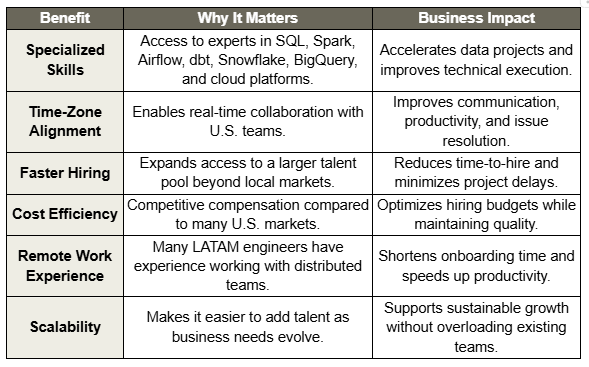
Key takeaway: Hiring remote data engineers in LATAM provides a combination of technical expertise, geographic alignment, and scalability, making it an effective strategy for U.S. companies looking to accelerate data initiatives (Report, Revelo).
How to Recruit Remote Data Engineers Successfully
Hiring success starts with clearly defining the role and expected business outcomes.
Before launching a search, organizations should identify:
- Data architecture requirements
- Pipeline ownership expectations
- Cloud infrastructure needs
- Data governance requirements
- Security responsibilities
- Stakeholder interaction expectations
1. Assess Real-World Technical Skills
The most effective evaluations mirror actual job responsibilities.
Recommended assessments include:
Pipeline Design Exercise
Ask candidates to design an ETL or ELT workflow using anonymized data.
Data Quality Testing
Evaluate their ability to implement validation frameworks and monitoring processes.
Documentation Review
Assess communication and documentation quality.
Version Control Practices
Review Git workflows and deployment methodologies.
2. Use Structured Candidate Evaluation
Traditional resumes rarely provide sufficient insight into engineering capabilities.
Interfell enhances hiring accuracy through structured evaluations and SPK (Simera Professional Key), an AI-powered candidate dossier that combines:
- Verified candidate information
- Skills validation
- Competency scorecards
- Professional evidence
- Performance indicators
This allows hiring managers to compare candidates consistently and objectively.
How to Onboard Remote Data Engineers in 90 Days
A structured onboarding process significantly improves retention and accelerates productivity (Timify).
Phase 1: Initial Integration (Days 1–30)
Organizations should:
- Provision system access before Day One
- Share architecture documentation
- Review security protocols
- Introduce team workflows
- Assign a mentor or technical buddy
Phase 2: Guided Contribution (Days 30–60)
Engineers begin contributing to active projects while receiving ongoing support.
Common activities include:
- Maintaining existing pipelines
- Fixing data quality issues
- Participating in sprint ceremonies
- Reviewing code and documentation
Phase 3: Progressive Autonomy (Days 60–90)
Data engineers gradually assume ownership of production workloads.
Typical responsibilities include:
- Pipeline ownership
- Monitoring and observability
- Performance optimization
- Incident response
- Deployment management
Managing Distributed Data Engineering Teams
High-performing remote teams require clear expectations and measurable outcomes (365datascience).
Recommended KPIs include:
- Time to productivity
- Deployment frequency
- Pipeline reliability
- Data quality scores
- Mean Time to Recovery (MTTR)
- Incident frequency
- Documentation completeness
Organizations should also adopt modern DataOps practices, such as:
- CI/CD for data pipelines
- Infrastructure as Code
- Automated testing
- Continuous monitoring
- Observability platforms
Regular communication rituals should include:
- Daily standups
- Weekly one-on-ones
- Sprint retrospectives
- Architecture reviews
- Career development discussions
Security and Compliance Best Practices
Because remote data engineers often work with sensitive information, security must remain a priority (Y-axis).
Organizations should:
- Apply least-privilege access controls
- Use role-based permissions
- Implement audit logging
- Monitor access continuously
- Use anonymized datasets during onboarding
- Enforce compliance requirements relevant to their industry
Strong security processes reduce operational risk while enabling effective remote collaboration.
How Interfell Helps Companies Hire Data Engineers
Interfell helps U.S. companies build remote data engineering teams across LATAM and Spain through specialized recruitment, structured candidate evaluations, and remote workforce management.
With access to a network of more than 2.5 million professionals, Interfell identifies qualified data engineers with expertise in modern data stacks, cloud platforms, and analytics infrastructure.
To improve hiring accuracy, Interfell leverages SPK (Simera Professional Key), an AI-powered candidate dossier that combines verified information, competency assessments, and performance evidence. Companies can also use the Smart Hiring Salary Guide 2027 to benchmark compensation and create competitive offers.
By combining talent expertise, salary intelligence, and AI-powered evaluations, Interfell helps organizations hire remote data engineers faster and with greater confidence.
Key Takeaways
Organizations seeking to scale their data capabilities should:
- Adopt a remote-first hiring strategy.
- Build structured onboarding programs.
- Define measurable performance indicators.
- Invest in documentation and collaboration.
- Implement DataOps best practices.
- Prioritize security and compliance.
- Partner with experienced talent specialists familiar with LATAM markets.
With access to more than 2.5 million professionals globally, over a decade of recruiting expertise, AI-powered SPK candidate evaluations, and the Smart Hiring Salary Guide 2027, Interfell helps organizations build remote data engineering teams efficiently and securely.
Interfell Related Articles
FAQs
1. What does a remote data engineer do?
A remote data engineer designs, builds, and maintains data pipelines, storage systems, and analytics infrastructure while working from a location outside the employer's office.
2. Why hire data engineers from LATAM?
LATAM offers highly skilled professionals, time-zone alignment with U.S. companies, and competitive compensation.
3. What skills should a data engineer have?
Most employers seek expertise in SQL, Python, Spark, Airflow, dbt, cloud platforms, and modern data warehousing solutions.
4. How long should onboarding take?
Most successful organizations use a structured 90-day onboarding framework.
5. How can remote data engineers be managed effectively?
Clear KPIs, regular communication, documented processes, and DataOps practices are essential.
6. What security measures are recommended?
Role-based access controls, least-privilege permissions, monitoring, audit logs, and secure testing environments.
7. How can companies reduce hiring risks?
Structured assessments, verified references, competency-based evaluations, and specialized recruitment partners can improve hiring outcomes.
Quick Glossary
-
Data Engineer: A professional responsible for building and maintaining data infrastructure.
-
DataOps: Practices that improve reliability and efficiency in data delivery.
-
CI/CD: Continuous Integration and Continuous Deployment processes.
-
MTTR: Mean Time to Recovery after an incident.
-
Data Lake: Centralized repository for storing large amounts of structured and unstructured data.
-
Role-Based Access Control (RBAC): A security framework based on user roles.
-
Data Pipeline: Automated workflow that moves and transforms data.