


Summary
Scaling a Data Labeling team does not have to mean hiring more full-time employees, increasing administrative workload, or taking on higher fixed costs. For U.S. companies developing artificial intelligence solutions, a strategy built around remote talent, standardized processes, and quality controls can expand labeling capacity while maintaining flexibility.
Want to see real profiles? Browse AI and machine learning engineers in Latin America with video and salary ranges on Interfell's talent search.
This article explains how to scale effectively, why Latin America is a strategic region for talent acquisition, and how a remote staffing model can reduce operational complexity.
Table of Contents
- Introduction
- The Real Cost of Expanding an In-House Team
- How to Scale Without Increasing Fixed Headcount
- In-House Teams vs. Flexible Staffing
- Why Latin America Is a Strategic Region
- How to Maintain Data Labeling Quality at Scale
- Benefits of Outsourcing Data Labeling
- How to Build a Scalable Data Labeling Operation
- How Interfell Can Help
- Interfell Related Articles
- FAQs
- Quick Glossary
Introduction
The growth of artificial intelligence is driving demand for data that has been accurately classified, reviewed, and prepared for machine learning model training.
According to estimates from research firms such as Coherent Market Insights and Mordor Intelligence, the global Data Labeling market and related services are expected to grow significantly over the coming years. This expansion is being fueled by projects involving computer vision, natural language processing, autonomous driving, virtual assistants, recommendation systems, and business automation.
However, this market growth also creates an operational challenge: companies need to process larger volumes of data without turning every new project into a permanent expansion of their internal workforce.
The question is no longer simply how large a team should become, but how to scale a Data Labeling team without disproportionately increasing internal costs (LinkedIn).
Market Overview
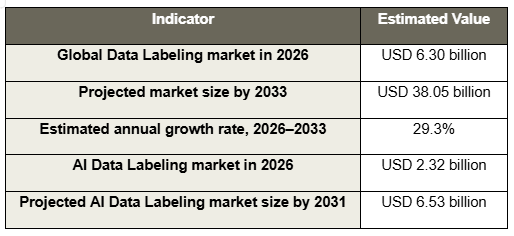
Reference sources: Coherent Market Insights and Mordor Intelligence.
Figures may vary across studies because some research firms assess the broader data labeling market, while others focus specifically on services related to artificial intelligence.
The Real Cost of Expanding an In-House Team
The cost of growing an internal team extends far beyond salaries.
It may also include:
- recruitment and candidate assessment;
- onboarding and training;
- supervision;
- software licenses and tools;
- technology infrastructure;
- administrative and legal management;
- performance monitoring;
- employee turnover and replacement.
As the team expands, product, data, and engineering leaders may spend more time managing people and processes and less time on strategic priorities (Annotera).
The solution is to build flexible capacity that can increase or decrease based on project demand.
How to Scale Data Labeling Without Increasing Fixed Headcount
The most effective strategy combines remote staffing, clear documentation, role specialization, and measurable performance indicators.
1. Use Flexible Staffing
Instead of opening permanent positions, companies can bring in talent based on:
- project duration;
- data volume;
- language requirements;
- task complexity;
- model training stage;
- review and validation needs.
This model makes it possible to respond to workload peaks without maintaining an oversized workforce during slower periods.
2. Define Roles and Responsibilities
A scalable team may include:
- data annotators;
- reviewers;
- quality assurance specialists;
- team leads;
- subject-matter experts.
Separating these responsibilities improves workflow control and reduces the likelihood of errors.
3. Document the Instructions
Guidelines should include:
- category definitions;
- correct and incorrect examples;
- acceptance criteria;
- edge cases;
- escalation rules;
- review procedures.
Clear documentation speeds up onboarding and reduces the need for constant supervision.
4. Implement Quality Controls
Some of the most effective practices include:
- calibration tests;
- sample-based reviews;
- double annotation;
- gold-standard datasets;
- inter-annotator agreement measurement;
- recurring error analysis.
5. Measure Performance
Recommended metrics include:
- accuracy;
- acceptance rate;
- volume processed;
- time per task;
- rework rate;
- cost per unit;
- on-time delivery rate.
These indicators help teams identify problems before they affect large volumes of data.
In-House Data Labeling vs. Flexible Staffing
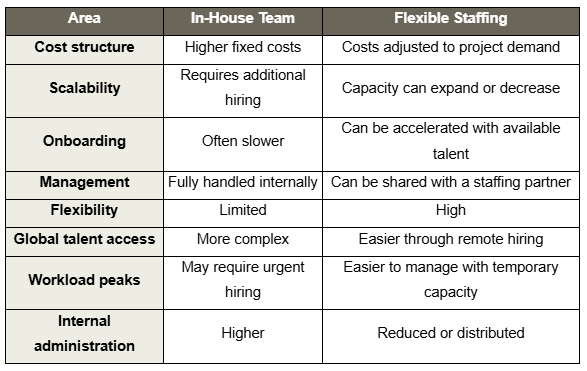
Reference sources: LatHire, and LinkedIn Insights.
Flexible staffing does not mean giving up control.
The company continues to define:
- project goals;
- labeling standards;
- security requirements;
- quality thresholds;
- deadlines;
- performance metrics.
The difference is that execution, talent sourcing, onboarding support, and part of the administrative workload can be shared with an external partner.
Why Latin America Is a Strategic Region
Latin America has become an increasingly relevant talent market for U.S. companies seeking remote professionals in technology, digital operations, and artificial intelligence.
Time Zone Compatibility
Similar or overlapping time zones make it easier to manage:
- real-time meetings;
- fast responses to questions;
- coordination with product teams;
- reviews during regular business hours.
Specialized Talent
The region offers professionals with experience in:
- technology;
- data analysis;
- quality assurance;
- digital operations;
- artificial intelligence;
- multilingual projects.
Competitive Costs
Hiring in Latin America can help companies balance quality, experience, and total operating costs. The goal should not be to hire based on price alone, but to build a sustainable and reliable team.
Linguistic Diversity
Latin America is also highly valuable for projects involving Spanish, English, or Portuguese data, particularly in areas such as natural language processing, sentiment analysis, and virtual assistants.
How to Maintain Data Labeling Quality at Scale
Quality depends less on whether the team is internal or external and more on the strength of the processes supporting it.
To maintain high standards, companies should:
- conduct a pilot project;
- use previously validated data;
- review samples continuously;
- increase oversight when errors appear;
- update the guidelines regularly;
- analyze the root causes of recurring issues.
An error may indicate that a category is poorly defined, an edge case has not been documented, or the training process was insufficient.
Addressing the cause prevents the same problem from being repeated at scale.
Benefits of Outsourcing Data Labeling
An outsourcing or remote staffing model can provide:
- greater flexibility;
- reduced administrative workload;
- faster access to specialized talent;
- better responsiveness during workload peaks;
- more predictable costs;
- greater focus for internal teams.
It also allows internal specialists to concentrate on data strategy, model evaluation, product development, and innovation (Subul Data Annotation)
How to Build a Scalable Data Labeling Operation
Step 1: Define the Scope
Specify the data type, volume, language, level of complexity, required tools, and delivery deadlines.
Step 2: Establish Metrics
Define minimum accuracy, review percentages, acceptable error tolerance, and turnaround times.
Step 3: Document the Process
Create clear guidelines, examples, rules, and criteria for special or ambiguous cases.
Step 4: Launch a Pilot
Test the workflow with a small team and a representative sample of the data.
Step 5: Add Talent Gradually
Increase capacity only after validating quality, productivity, and costs.
Step 6: Review and Improve
Update the guidelines whenever the data, categories, or model objectives change.
How Interfell Can Help
Interfell supports companies in the United States, Latin America, and Spain through IT Recruitment, Remote Staffing, and Talent Management services.
For Data Labeling and artificial intelligence projects, Interfell can assist with:
- identifying qualified talent;
- comparing candidate profiles;
- building remote teams;
- defining salary ranges;
- evaluating candidates;
- hiring professionals according to project demand.
Interfell has more than a decade of experience and access to a network of over 2.5 million professionals.
The 2027 Smart Hiring Salary Guide for Latin America can help companies plan their budgets, while SPK, the Simera Professional Key, can support automated candidate evaluation.
Need to Expand Your Data Labeling Capacity?
Scale your data labeling team with Interfell!
Interfell Related Articles
-
How to Hire Remote Data Labelers in Latin America for AI Projects
-
Where to Hire AI Engineers in LATAM: Costs, Countries & Availability
FAQs
1. What is Data Labeling?
Data Labeling is the process of classifying, identifying, or adding information to data such as images, text, audio, video, or documents. These labels help artificial intelligence models recognize patterns and generate predictions.
2. How can a Data Labeling team be scaled?
A team can be scaled through flexible staffing, remote hiring, standardized documentation, gradual onboarding, quality controls, and productivity metrics.
3. What are the advantages of outsourcing Data Labeling?
Outsourcing can reduce administrative workload, improve access to specialized talent, accelerate onboarding, and make it easier to adjust capacity according to project volume.
4. How can quality be maintained in a remote team?
Quality can be maintained through calibration tests, gold-standard datasets, double annotation, sample-based reviews, inter-annotator agreement measurement, and error analysis.
5. Why hire Data Labeling talent in Latin America?
Latin America offers time zone compatibility with the United States, access to technology professionals, linguistic diversity, and competitive cost structures.
6. Which metrics should be used in a data labeling project?
Common metrics include accuracy, productivity, acceptance rate, rework percentage, time per task, inter-annotator agreement, and cost per labeled unit.
7. When is flexible staffing most useful?
Flexible staffing is especially useful when workload volumes change frequently, projects experience temporary peaks, assignments have defined timelines, additional languages are required, or the company wants to avoid permanently expanding its workforce.
Quick Glossary
- Data Labeling: The process of assigning categories or labels to data for use in training artificial intelligence models.
- Data Annotation: A broader term that may include detailed labeling methods such as bounding boxes, segmentation, transcription, classification, or entity relationships.
- Gold-Standard Dataset: A set of annotations reviewed and approved by experts that serves as a benchmark for quality.
- Remote Staffing: A workforce model in which companies add remote professionals according to operational or project needs.
- Quality Assurance: The processes used to verify that annotations meet established standards and accuracy requirements.
- Inter-Annotator Agreement: A measurement of how consistently different annotators label the same data.
- Operational Overhead: Indirect costs associated with recruiting, managing, supervising, equipping, and coordinating a team.