


Summary
Data labelers classify, annotate, and validate the data used to train artificial intelligence models. For U.S. companies looking to scale this work, hiring remote talent in Latin America can offer an attractive combination of quality, time-zone alignment, flexibility, multilingual capabilities, and competitive costs.
Want to see real profiles? Browse AI and machine learning engineers in Latin America with video and salary ranges on Interfell's talent search.
This guide explains what a data labeler does, estimated compensation in LATAM, and how U.S. companies can build, evaluate, and manage a reliable remote data labeling team.
Table of Contents
- Introduction
- What Is a Data Labeler and Why Is This Role Critical for AI Companies?
- Strategic Advantages of Hiring Remote Data Labelers in LATAM
- How to Build a Reliable Remote Data Labeling Team
- Best Practices for Managing Remote Data Labelers
- Final Thoughts
- Interfell Related Articles
- FAQs
- Quick Glossary
Introduction
In today's artificial intelligence ecosystem, properly labeled data is the fuel behind more accurate, efficient, and reliable models. At the center of this process are data labelers, professionals who transform raw information into structured data that can be used to train machine learning algorithms.
AI adoption is also expanding rapidly across the U.S. business landscape. According to the U.S. Census Bureau's Business Trends and Outlook Survey, overall AI use among U.S. businesses ranged between 17% and 20% from December 2025 through May 2026, reaching approximately 37% among companies with 250 or more employees.
For U.S. startups, AI companies, SaaS businesses, and enterprises looking to scale AI projects without compromising quality or dramatically increasing operating costs, building a remote data labeling team in Latin America can be an increasingly attractive strategy.
LATAM combines a growing remote talent market with competitive compensation, cultural proximity, multilingual professionals, and significant overlap with U.S. working hours—making the region particularly well positioned for nearshore AI and data operations.
What Is a Data Labeler and Why Is This Role Critical for AI Companies?
A data labeler, or data annotator, is a professional responsible for labeling, classifying, and validating information so AI models can recognize patterns and make decisions.
They may work with text, images, audio, video, documents, or multimodal data, identifying objects, entities, emotions, categories, relationships, or other attributes according to predefined criteria.
Although some tasks can be repetitive, effective data labeling requires attention to detail, contextual understanding, consistency, and the ability to follow precise instructions. Errors during this stage can reduce model accuracy or introduce unwanted bias.
Typical responsibilities include:
- Classifying and annotating data.
- Identifying objects, entities, or patterns.
- Correcting automatically generated labels.
- Validating data quality.
- Detecting inconsistencies.
- Handling ambiguous cases.
- Participating in calibration and QA sessions.
As AI becomes more sophisticated, these professionals are also becoming increasingly relevant to human-in-the-loop workflows, where human judgment is used to review and improve AI-generated results.
Strategic Advantages of Hiring Remote Data Labelers in LATAM
Latin America has become a strategic nearshore market for U.S. companies building remote teams across technology, data operations, and artificial intelligence.
For data labeling operations, several advantages stand out:
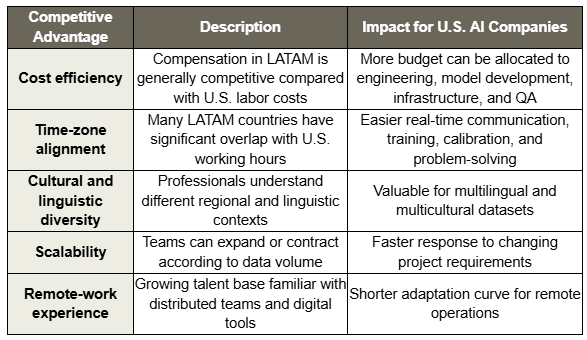
Time-zone compatibility is particularly valuable for U.S. organizations. Teams in countries such as Mexico, Argentina, Colombia, Peru, Uruguay, and Venezuela can often collaborate with American managers, engineers, and QA specialists during the same business day.
This can make it easier to clarify labeling rules, review edge cases, conduct calibration sessions, and resolve quality issues without the delays often associated with more distant offshore locations.
LATAM Data Labeler Salaries in 2026
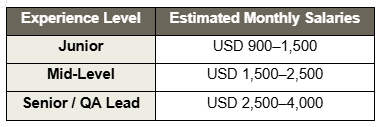
Source: Interfell's 2027 LATAM Salary Guide
These figures are estimates and may vary according to:
- Country of residence.
- English or Portuguese proficiency.
- Dataset complexity.
- Experience with annotation tools.
- Required specialization.
- Hiring model.
- Security and confidentiality requirements.
- Project duration and volume.
Projects involving specialized fields such as healthcare, finance, insurance, legal services, cybersecurity, or autonomous vehicles may require professionals with technical or industry knowledge, which can increase compensation.
For U.S. employers, however, the goal should not simply be finding the lowest possible rate. Accuracy, consistency, retention, and productivity can have a major impact on the total cost of a data labeling operation.
Practical assessments and up-to-date compensation benchmarks can therefore help companies reduce hiring risks.
Recruiting and staffing partners such as Interfell, with more than a decade of experience in IT recruitment, remote staffing, and talent management, can help U.S. organizations access qualified LATAM professionals without managing every individual search and hiring process internally.
How to Build a Reliable Remote Data Labeling Team
1. Define Your Project Requirements
Before hiring, establish:
- Data type: text, images, audio, video, LiDAR, or others.
- Volume and complexity: number of samples and level of detail.
- Required languages: English, Spanish, Portuguese, or others.
- Deadlines: schedule and project milestones.
- Quality metrics: accuracy and acceptable error rates.
- Security requirements: confidentiality and intellectual property.
Clear requirements make candidate selection easier and help prevent productivity and quality issues.
2. Create Clear and Visual Labeling Guidelines
Many data labeling problems originate from ambiguous instructions.
A strong guideline should include:
- Category definitions.
- Classification rules.
- Positive and negative examples.
- Edge cases.
- Exceptions.
- Procedures for reporting questions.
- Delivery format.
Screenshots, annotated examples, and practical exercises can help reduce inconsistencies.
Guidelines should also evolve throughout the project. When new edge cases appear, decisions should be documented and communicated to the entire team.
3. Design Effective Hiring Assessments
Candidates should be evaluated using tasks similar to the actual project.
The assessment should measure:
- Accuracy.
- Speed.
- Understanding of instructions.
- Consistency.
- Attention to detail.
- Handling of ambiguous cases.
- Written communication.
Platforms such as SPK (Simera Professional Key), developed by Simera in partnership with Interfell, can support automated evaluation of technical and soft skills.
4. Establish Quality Control Processes
Quality assurance (QA) is essential for maintaining reliable standards.
Recommended practices include:
- Random reviews.
- Double validation for critical cases.
- Calibration sessions.
- Gold-standard data.
- Individual and team metrics.
- Periodic audits.
- Retraining after recurring errors.
Useful metrics include accuracy, inter-annotator agreement, time per task, and rework rate.
The goal is to detect quality problems early—before they affect large portions of the training dataset.
5. Choose the Right Hiring Model
Common options include:
- Freelancers: for short-term or low-volume projects.
- Remote employees: for stable operations.
- Remote staffing: for access to vetted talent and administrative support.
- Dedicated teams: for long-term projects.
- Project-based models: when scope and deliverables are clearly defined.
For U.S. companies, LATAM can offer an attractive balance between domestic hiring and traditional offshore outsourcing by combining international talent costs with strong time-zone compatibility.
Partners such as Interfell can provide access to specialized professionals across multiple Latin American countries while reducing the burden of recruiting and managing individual hiring processes.
Best Practices for Managing Remote Data Labelers
Once the team is hired, daily management will determine the quality, stability, and productivity of the operation.
Communication and Tools
Define official communication channels, expected response times, and procedures for resolving questions.
Useful tools include:
- Slack or Microsoft Teams.
- Jira, Asana, or Trello.
- Notion or Confluence.
- Google Drive or SharePoint.
- Specialized data annotation platforms.
It is also important to determine which issues can be resolved through chat, which require meetings, and which decisions must be documented.
Changes to labeling criteria should always be recorded and communicated across the team.
Structured Onboarding
A strong onboarding process should include:
- Project objectives.
- Tool training.
- Review of labeling guidelines.
- Practical exercises.
- Explanation of quality metrics.
- Pilot tests.
- Immediate feedback.
- Assignment of a mentor or QA Lead.
Before scaling volume, run a pilot phase. This helps identify problems with instructions, tools, workflows, or quality criteria before committing large datasets.
Incentives and Retention
Retention matters because experienced labelers understand project-specific criteria better and generally require less supervision.
Recommended practices include:
- Recognizing strong quality performance.
- Providing frequent feedback.
- Creating growth opportunities.
- Paying on time.
- Maintaining reasonable workloads.
- Offering continuous training.
- Creating paths toward QA or team-lead roles.
- Avoiding incentives based solely on speed.
Incentives should balance productivity and quality. Rewarding only the number of completed tasks can increase errors and generate costly rework.
Final Thoughts
Building a reliable remote data labeling team can be a strategic investment for U.S. companies looking to scale AI initiatives with greater flexibility and cost efficiency.
Latin America offers a compelling combination of talent, time-zone compatibility, cultural and linguistic diversity, remote-work experience, and competitive compensation.
The key is to define requirements clearly, create detailed guidelines, evaluate candidates through practical assessments, and maintain continuous QA.
With these foundations, companies can build higher-quality datasets and train more accurate, useful, and reliable AI models.
Working with a specialized partner such as Interfell, combining vetted LATAM talent, compensation benchmarks, recruiting expertise, and candidate assessment tools, can make scaling these operations significantly easier.
Ready to build a high-performing remote data labeling team?
Connect with Interfell and access specialized AI and data talent across LATAM
Interfell Related Articles
FAQs
1. What does a data labeler do?
A data labeler classifies, annotates, and validates information used to train artificial intelligence models.
2. Why are data labelers important for AI?
Because the quality of training data directly influences the accuracy and reliability of AI models.
3. Why hire data labelers in Latin America?
LATAM offers competitive compensation, U.S. time-zone overlap, multilingual talent, remote-work experience, and access to a growing technology workforce.
4. How much does a data labeler earn in LATAM?
Estimated compensation ranges from approximately USD 900 to USD 4,000 per month depending on experience, country, language skills, and specialization.
5. How should candidates be evaluated?
Through practical assessments measuring accuracy, speed, consistency, attention to detail, and comprehension of instructions.
6. How can companies maintain labeling quality?
Through clear guidelines, audits, double validation, calibration sessions, gold-standard data, QA processes, and performance metrics.
7. What is the best hiring model?
It depends on project requirements. Freelancers can work for short-term needs, while remote employees, dedicated teams, or staffing solutions may be better for continuous operations.
Quick Glossary
- Data Labeler: Professional who labels and validates data used to train AI systems.
- Data Labeling: Process of assigning categories or attributes to raw data.
- Machine Learning: Technology that enables systems to learn patterns from data.
- QA: Quality assurance processes used to maintain labeling standards.
- Gold Data: Expert-validated data used as a quality reference.
- NLP: Natural language processing applied to text and conversations.
- Human-in-the-Loop: AI workflow in which humans review, validate, or improve automated outputs.