

Summary
Hiring software developers in 2026 is no longer just about filling roles—it’s about building high-performing, scalable teams in a global talent market. With a shortage of over 1.2 million IT professionals in the U.S. and the rise of remote LATAM talent, companies must adopt smarter, faster, and more data-driven hiring strategies.
Want to see real profiles? Browse software engineers in Latin America with video on Interfell's talent search.
In this guide, you’ll learn how to:
- Reduce time-to-hire by up to 50%
- Improve candidate quality and retention
- Eliminate bias using AI recruitment tools
- Optimize compensation using real market data
Table of Contents
- Introduction
- How to Prepare for Developer Interviews
- How to Structure a Technical Interview
- Best Interview Questions by Seniority
- Tools for Modern Developer Hiring
- Common Developer Interview Mistakes
- How to Make Data-Driven Hiring Decisions
- How Interfell Helps You Hire Developers Faster
- Quick Answer: How to Interview Developers in 2026
- Conclusion
- FAQs
- Glossary
Introduction
The global competition for developers has intensified. Companies are increasingly turning to remote hiring and nearshoring in Latin America to access skilled talent while maintaining time-zone alignment.
However, traditional hiring methods are no longer effective. According to McKinsey’s 2025 HR Monitor, offer acceptance rates are just 56%, 18% of new hires leave during their probationary period, and overall hiring success stands at only 46% in Europe—clear signs that traditional hiring methods are falling short (McKinsey & Company).
The challenge today is not access to talent—it’s accurate evaluation.
How to Prepare for Developer Interviews
1. Define Technical Competencies by Seniority
- Junior: Programming fundamentals, Git, data structures
- Mid-level: APIs, microservices, CI/CD pipelines
- Senior: System architecture, scalability, leadership
2. Evaluate Remote-Ready Soft Skills
- Asynchronous communication
- Cross-cultural collaboration
- English proficiency (B2+)
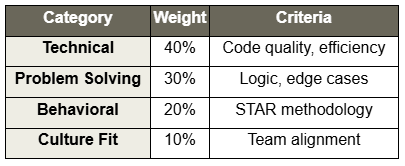
3. Build a Structured Scoring System
A structured interview framework ensures consistent and fair evaluations.
4. Use AI for Objective Evaluation
Modern hiring relies on AI recruitment tools to analyze candidates objectively. These tools evaluate:
- Technical and soft skills
- Language proficiency
- Professional experience
- Interview performance
AI-powered systems help reduce bias and improve hiring accuracy.
How to Structure a Technical Interview
The most successful interviews follow a clear, consistent structure that candidates are familiar with in advance. This enhances the candidate's experience and simplifies the decision-making process.
Phase 1: Screening (20 minutes)
- Resume validation
- Quick technical questions
- Communication assessment
Phase 2: Technical Deep Dive (60–90 minutes)
- Live coding exercises using coding interview tools
- System design challenges
- Pair programming simulations
Phase 3: Behavioral Interview (45 minutes)
- Real-world problem-solving scenarios
- Conflict resolution in remote teams
- Adaptability to distributed environments
Include a Reverse Interview
Allow candidates to ask questions. This helps assess curiosity, engagement, and cultural fit.
Best Interview Questions by Seniority
-
Junior Developers
- Basic algorithms
- Language fundamentals
-
Mid-Level Developers
- System design basics
- Optimization scenarios
-
Senior Developers
- Architecture decisions
- Scaling systems
- Performance monitoring
-
Behavioral Questions (All Levels)
- How do you handle production failures?
- Describe a remote collaboration challenge.
- What impact did your last project have?
Tools for Modern Developer Hiring
Hiring developers in 2026 is deeply technology-driven.
1. Essential Tools
- Coding platforms: CoderPad, HackerRank
- Design tools: Excalidraw, Lucidchart
- ATS systems: Lever, Greenhouse
2. Salary Intelligence for Competitive Offers
Using developer salary benchmarks is critical for attracting top talent. Data-driven salary insights help companies remain competitive without overspending.
Common Developer Interview Mistakes
- Over-reliance on algorithm tests
- Bias in evaluation without structured systems (Stackoverflow)
- Long hiring processes (over 4 weeks) (Recruiter)
- Poor candidate experience and communication
Key Fact: Avoiding these mistakes is critical. In fact, according to LinkedIn’s Global Talent Trends report, 49% of candidates have declined a job offer due to a poor hiring experience, highlighting how process quality directly impacts hiring success (LinkedIn)
How to Make Data-Driven Hiring Decisions
After interviews:
- Conduct debriefs within 24 hours
- Use scoring systems for evaluation
- Ensure alignment across interviewers
Improve Offer Acceptance
- Offer competitive compensation
- Provide remote work benefits
- Implement structured onboarding plans
How Interfell Helps You Hire Developers Faster
In a competitive global market, having the right hiring partner makes a difference.
Interfell supports companies with:
- IT recruitment
- Remote staffing
- Payroll solutions
It also enhances hiring with:
-
Smart Hiring Salary Guide 2027
Understand salary benchmarks and hiring trends across LATAM.
-
Simera Professional Key (SPK)
An AI-powered system developed by Simera that analyzes thousands of data points to ensure accurate and unbiased hiring decisions.
How to Interview Software Developers in 2026 (Quick Answer)
1. Define technical and soft skills by seniority2. Use a structured interview framework
3. Include real-world coding and system design tasks
4. Apply AI tools to reduce bias
5. Make fast, data-driven hiring decisions
Conclusion
Interviewing developers in 2026 requires more than intuition—it requires structure, data, and technology.
Companies that combine:
- Structured interview frameworks
- AI-powered evaluation
- Market intelligence tools
These are the ones that will win the global talent war.
Are you ready to hire faster and smarter?
Explore how Interfell connects you with pre-vetted developers and helps you scale your team efficiently.
Interfell Related Articles
FAQs
1. What is the best way to interview software developers?
Use structured interviews, real-world coding tasks, and AI-based evaluation tools to ensure objective and accurate assessments.
2. How long should a hiring process take?
Ideally, less than 4 weeks. Longer processes increase the risk of losing top candidates to competitors.
3. Are coding tests effective?
Yes, but only when combined with real-world scenarios, system design exercises, and practical problem-solving.
4. Why hire developers from LATAM?
LATAM offers highly skilled talent, cost efficiency, and strong time-zone alignment with U.S. companies.
5. What skills matter most for remote developers?
Beyond technical skills, asynchronous communication, autonomy, English proficiency, and cross-cultural collaboration are critical.
6. How can companies reduce bias in hiring?
By implementing structured scoring systems and using AI-powered tools that evaluate candidates based on standardized criteria.
7. What improves developer retention after hiring?
Competitive compensation, clear career paths, strong onboarding, and a positive remote work culture significantly improve retention rates.
Glossary
-
ATS (Applicant Tracking System): Software used to manage recruitment processes and candidate pipelines.
-
CI/CD (Continuous Integration/Continuous Deployment): Practices that automate software testing and deployment.
-
Coding Interview Platforms: Tools like HackerRank or CoderPad are used to assess technical skills in real time.
-
Nearshoring: Hiring talent from nearby countries with similar time zones (e.g., LATAM for U.S. companies).
-
System Design: The process of defining architecture, components, and data flow for scalable applications.
-
AI Recruitment Tools: Technologies that analyze candidate data to improve hiring accuracy and reduce bias.
-
Structured Interview Framework: A standardized approach to evaluating candidates using consistent criteria and scoring systems.