


Summary
Hiring remote Data Labelers in LATAM is a strategic move for companies that need to scale artificial intelligence projects with reliable data, competitive costs, and teams aligned with U.S. time zones.
Want to see real profiles? Browse AI and machine learning engineers in Latin America with video and salary ranges on Interfell's talent search.
Data Labelers are responsible for labeling, classifying, and validating data such as text, images, audio, and video to train machine learning models. Their work directly impacts the accuracy, consistency, and performance of AI systems.
In this guide, you will learn what a Data Labeler does, why LATAM is a strategic region for AI talent, which skills to evaluate, how much it may cost to hire these professionals, and how to structure an efficient, ethical, and scalable hiring process.
Table of Contents
- Introduction
- Why Hire Remote Data Labelers in LATAM
- What Does a Data Labeler Do?
- Types of Data Labeling Projects
- Salary Ranges in LATAM
- Key Skills to Look For
- How to Hire Remote Data Labelers
- Quality KPIs
- Ethical and Compliance Considerations
- How Interfell Can Help
- Interfell Related Articles
- FAQs
- Quick Glossary
Introduction
Every high-impact artificial intelligence initiative depends on a solid foundation of accurately labeled data. When data labeling is inconsistent, incomplete, or inaccurate, models may be trained on noisy datasets, reproduce bias, and lose performance once deployed in real-world environments (FactMR).
Data labeling, also known as data annotation, is the process in which human professionals classify, tag, validate, and organize raw data. This data may include text, images, audio, video, or multimodal information. Through these labels, algorithms learn patterns and generate more reliable predictions.
In other words, Data Labelers are a key part of the AI lifecycle. Their work directly influences model accuracy, dataset quality, error reduction, and the speed at which an AI solution can move from development to real-world use (FactMR).
Why Hire Remote Data Labelers in LATAM?
LATAM has become a strategic region for hiring remote talent for AI projects. Its main advantages include:
1. Competitive costs
LATAM allows companies to build data labeling teams with a stronger cost-benefit ratio compared to hiring local talent in the United States.
2. Time zone alignment
Similar time zones make it easier to coordinate meetings, quality reviews, calibration sessions, and real-time communication with North American teams (Hire in South).
3. Bilingual talent
Many professionals in LATAM are proficient in both Spanish and English, which is especially valuable for NLP projects, sentiment analysis, global support, and multicultural products (Lathire).
4. Scalability
Companies can expand or reduce their teams depending on data volume, project stage, or QA needs (Lathire).
5. Remote work experience
The region has a growing base of professionals familiar with digital tools, distributed teams, and international collaboration.
What Does a Data Labeler Do?
A Data Labeler is responsible for preparing data so it can be used to train, validate, or fine-tune machine learning models.
Their tasks may include:
- Classifying text, images, audio, or video.
- Identifying objects, entities, emotions, intentions, or categories.
- Correcting automatically generated labels.
- Validating dataset quality.
- Applying annotation guidelines accurately.
- Detecting inconsistencies, ambiguities, or edge cases.
- Escalating questions to quality leads or project managers.
- Participating in calibration sessions to improve team consistency.
Although some tasks may seem simple, data labeling requires attention to detail, contextual understanding, and discipline to apply criteria consistently. In more advanced projects, it may also require domain knowledge, basic technical expertise, or specialized language skills.
Types of Data Labeling Projects
Remote Data Labelers in LATAM can support different types of AI projects, including:
-
Image labeling: Object detection, classification, segmentation, and computer vision tasks.
-
Text annotation: Sentiment analysis, document classification, entity extraction, and intent identification.
-
Audio labeling: Transcription, speaker diarization, language classification, and emotion annotation.
-
Video annotation: Object tracking, activity recognition, and behavior analysis.
-
Data quality: Auditing, correcting, validating, and improving existing datasets.
Salary Ranges for Data Labelers in LATAM
Compensation for Data Labelers in LATAM may vary depending on the country, level of experience, project complexity, technical domain, language requirements, and hiring model.
As a 2026 reference:
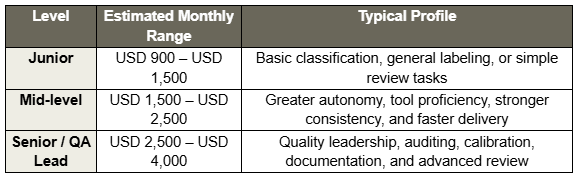
These figures should be used as a reference, not as fixed rates. More complex projects, such as medical, legal, financial, technical, or multilingual annotation, may require more specialized profiles and higher compensation.
It is also important to balance cost efficiency with fair compensation, appropriate benefits, and dignified working conditions (Advox.GlobalVoices). This helps reduce turnover, improve work quality, and protect the company’s reputation.
Key Skills a Data Labeler Should Have
Before hiring, define which skills are essential for your project. The most important ones include:
- Attention to detail: To apply labels accurately and avoid repetitive errors.
- Consistency: To follow the same criteria throughout the project.
- Ability to understand instructions: Especially when projects include extensive guidelines, edge cases, or complex rules.
- Language and contextual understanding: Essential for NLP, sentiment analysis, and content classification projects.
- Basic technical knowledge: Familiarity with annotation platforms, spreadsheets, dashboards, and collaborative tools.
- Remote work skills: Autonomy, clear communication, deadline management, and SLA compliance.
- Confidentiality: Particularly important for projects involving sensitive data or intellectual property.
How to Hire Remote Data Labelers in LATAM
1. Define the Project Requirements
Identify the type of data, volume, complexity level, languages, tools, deadlines, quality metrics, and security requirements.
2. Choose the Hiring Model
You can hire freelancers, build an internal remote team, use a specialized provider, or work with a nearshore partner. For scalable projects, a regional partner can support recruitment, evaluation, payroll, compliance, and operational follow-up (Precedence Research).
3. Select the Right Markets
Evaluate countries based on talent availability, English proficiency, time zone compatibility, connectivity, costs, and legal requirements (Lathire).
4. Design Selection Tests
Assess accuracy, speed, ability to understand instructions, consistency, handling of ambiguous cases, and communication skills.
5. Define Contracts, SLAs, and KPIs
Set clear expectations around deliverables, timelines, intellectual property, confidentiality, expected volume, maximum error rate, and review processes.
6. Implement Continuous QA
Use random reviews, double review for critical samples, quality leads, calibration sessions, and updated documentation to maintain consistency over time.
KPIs to Measure Data Labeling Quality
A data labeling team should be managed with clear metrics. Recommended KPIs include:
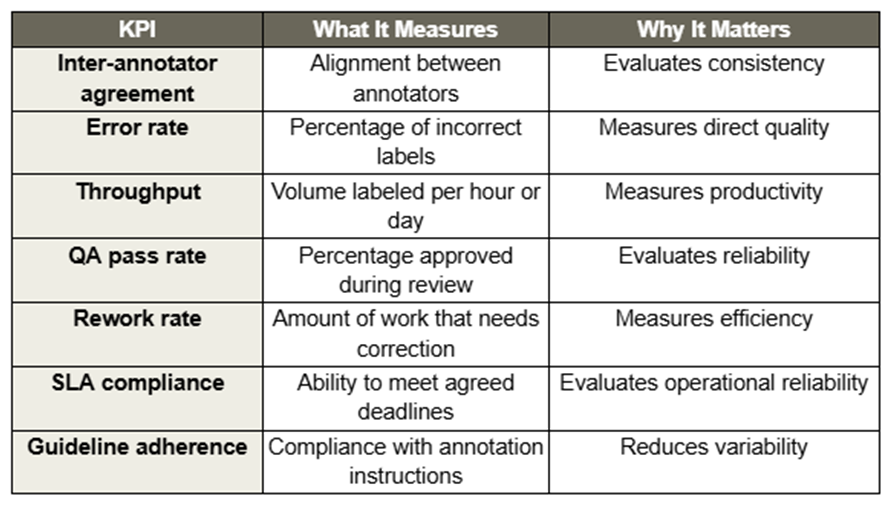
These metrics help detect issues early, compare team performance, and make data-driven decisions.
Ethical and Compliance Considerations
Data labeling creates job opportunities in LATAM, but it also requires responsibility. Companies should prioritize partners and hiring models that guarantee:
- Fair compensation.
- Dignified working conditions.
- Data protection.
- Confidentiality.
- Legal compliance.
- Contractual transparency.
- Worker well-being.
- Clear security and IP policies.
An ethical operation improves work quality, reduces turnover, and protects the company’s reputation (Advox GlobalVoices).
How Interfell Can Help
Interfell helps U.S. companies hire remote talent in LATAM for technology, artificial intelligence, and digital operations projects.
For data labeling teams, Interfell offers:
- Specialized recruitment.
- Access to a database of more than 2.5 million professionals.
- Candidate evaluation.
- Remote staffing.
- Payroll and operational support.
- Smart Hiring Salary Guide 2027.
- Evaluation tools such as SPK, Simera Professional Key.
Design a nearshore hiring strategy to accelerate your artificial intelligence projects with reliable talent, clear processes, and specialized support.
Hire vetted data labelers in LATAM with Interfell!
Interfell Related Articles
FAQs
1. What does a Data Labeler do?
A Data Labeler labels, classifies, validates, and organizes data so it can be used to train machine learning models. They may work with text, images, audio, video, or multimodal datasets.
2. Why hire Data Labelers in LATAM?
LATAM offers remote talent with competitive costs, strong time zone compatibility with the U.S., bilingual professionals, and growing experience in digital operations. This allows companies to scale AI projects with greater flexibility.
3. How much does it cost to hire a Data Labeler in LATAM?
Costs vary by country, experience level, and project complexity. As a reference, junior profiles may range from USD 900 to USD 1,500 per month, mid-level profiles from USD 1,500 to USD 2,500, and senior or QA Lead profiles from USD 2,500 to USD 4,000.
4. What skills should a good Data Labeler have?
A strong Data Labeler should have attention to detail, consistency, the ability to follow instructions, digital tool proficiency, remote work skills, and, in some cases, language proficiency or specific technical knowledge.
5. What types of data can a Data Labeler annotate?
A Data Labeler can annotate images, text, audio, video, and multimodal data. They may also support dataset review, auditing, correction, and quality control tasks.
6. How is data labeling quality measured?
Quality can be measured using KPIs such as inter-annotator agreement, error rate, throughput, QA pass rate, SLA compliance, and adherence to annotation guidelines.
7. How can Interfell help companies hire Data Labelers in LATAM?
Interfell helps companies find, evaluate, hire, and manage remote talent in LATAM. Its model combines specialized recruitment, remote staffing, payroll, candidate evaluation, and operational support to build scalable teams.
Quick Glossary
-
Data Labeling: The process of labeling data to train AI models.
-
Data Labeler: A professional who annotates, classifies, or validates data.
-
Machine Learning: A technology that allows systems to learn patterns from data.
-
NLP: Natural Language Processing applied to text or speech.
-
QA: Quality assurance for the labeling process.
-
Inter-annotator Agreement: A metric that measures consistency between annotators.
-
Nearshore: Hiring talent in nearby countries or compatible time zones.