

Summary
Hiring developers in Latin America in 2026 can cost approximately USD 25 to USD 125 per hour or more, depending on seniority, specialization, country, and hiring model.
Want to see real profiles? Browse software engineers in Latin America with video on Interfell's talent search.
For U.S. companies, LATAM offers an attractive combination of technology talent, time zone alignment, and competitive costs. However, hourly rates are only part of the total investment. Recruiting, contract administration, benefits, operational support, and time-to-hire can also affect the final cost.
This guide provides benchmark rates for junior, mid-level, senior, and specialized developers, along with cost differences by country, technical specialization, and hiring model.
Table of Contents
- Introduction
- How Much Does It Cost to Hire Developers in LATAM?
- Developer Rates by Country
- Costs by Seniority
- Costs by Specialization
- Direct Hiring vs. Nearshore Providers
- LATAM vs. the United States
- How to Calculate the Real Hiring Cost
- Interfell and Smart Hiring
- Final Thoughts
- Related Articles from Interfell
- FAQs
- Brief Glossary
Introduction
Hiring developers in Latin America has become an increasingly relevant strategy for U.S. companies looking to expand technology teams, accelerate digital projects, or access specialized skills without relying exclusively on the domestic labor market.
In 2026, a junior developer may cost around USD 25 per hour, while senior developers, tech leads, and specialists in artificial intelligence, cloud, DevOps, data, or cybersecurity can cost more than USD 85 per hour.
Determining how much it costs to hire developers in Latin America requires more than looking at a published hourly rate. Country of residence, experience, technology stack, English proficiency, time zone overlap with the United States, and hiring model can all directly influence the final cost.
The international market also continues to show strong demand for technology professionals. Software developers remain among the most sought-after profiles for companies building distributed teams and hiring beyond their local markets (Deel).
Interfell, a company specializing in IT Recruitment, Remote Staffing, and Talent Management, helps U.S. companies identify highly qualified professionals across Latin America and other strategic markets.
How Much Does It Cost to Hire a Developer in Latin America in 2026?
As a general benchmark, companies can use the following ranges when planning technology hires in LATAM:
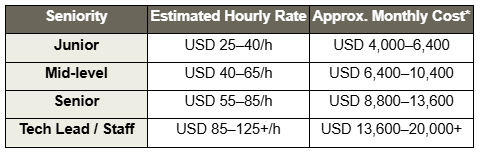
*Estimate based on 160 working hours per month.
For experienced professionals, a practical budgeting range is typically between USD 40 and USD 85 per hour. Specialists in artificial intelligence, data engineering, cloud, DevOps, and cybersecurity may command higher rates (Parallelstaff).
These figures are commercial benchmarks for remote or nearshore hiring and do not necessarily represent the developer’s net salary, since a provider’s rate may also include recruiting, administration, benefits, support, and other services.
Developer Rates by Country
Country can influence compensation, but it should not be the only criterion for evaluating talent.
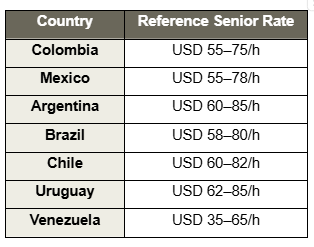
These ranges are indicative and can vary significantly among professionals within the same country (Hiretalent).
A developer with advanced English skills, experience working with U.S. companies, specialized technical expertise, and the ability to operate independently may command a rate well above the local market average.
Beyond location, companies should also evaluate:
- Experience with international teams.
- Spoken and written English proficiency.
- Availability during U.S.-compatible working hours.
- Technology stack and specialization.
- Ability to work autonomously.
- Experience with agile methodologies and distributed teams.
- Contract model and payment currency.
For this reason, comparing countries purely on price can lead to an incomplete hiring decision.
Costs by Seniority
Junior Developers
Junior profiles are generally well suited for maintenance, testing, documentation, and clearly defined tasks performed under technical supervision.
Their rates typically range from USD 25 to USD 40 per hour. Costs may increase when candidates have strong English skills, certifications, or experience with high-demand technologies.
Mid-Level Developers
Mid-level developers can usually own complete features, contribute to technical decisions, and work with moderate supervision.
A common planning range is USD 40 to USD 65 per hour.
Senior Developers
Senior developers bring greater autonomy, architectural experience, complex problem-solving capabilities, and the ability to mentor other team members.
In nearshore models, their rates generally range from USD 55 to USD 85 per hour (Nextideatech).
The difference between junior and senior talent is not based solely on years of experience. It also reflects the ability to make sound decisions, reduce technical risk, and accelerate product delivery.
Tech Leads and Specialists
Tech leads, software architects, and specialists in DevOps, AI, data, or cybersecurity may command USD 85 to USD 125 per hour or more, especially when they are responsible for architecture, security, or mission-critical systems.
Costs by Specialization
Technology stack and specialization also have a direct impact on budget.
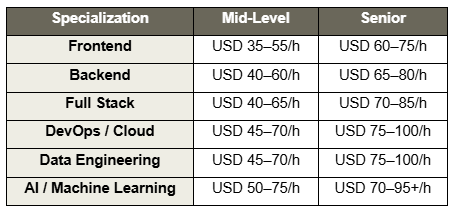
Professionals specializing in AI, data, cloud infrastructure, automation, and cybersecurity tend to fall toward the higher end of the market because of strong demand and a more limited supply of proven expertise.
Costs can also rise when a role requires knowledge of regulated industries, complex architectures, team leadership, or frequent interaction with U.S.-based clients and stakeholders.
Direct Hiring vs. a Nearshore Provider
An hourly rate does not necessarily represent the company’s total hiring cost.
Direct hiring may appear less expensive because there is no provider margin, but the company must manage sourcing, screening, contracts, international payments, compliance, and ongoing administration internally.
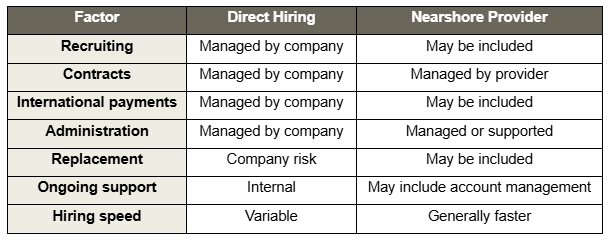
A nearshore provider may charge a higher nominal rate than the developer’s individual compensation, but it can also reduce time-to-hire, administrative burden, and certain operational risks.
The right comparison should therefore focus on the total cost of hiring, not just the hourly rate.
Latin America vs. the United States
One of the main reasons U.S. companies hire developers in LATAM is the ability to access specialized technology talent with a generally lower cost structure than in the U.S. market (Parallelstaff).
However, nearshoring should not be positioned only as a way to “pay less.”
For U.S. companies, working with LATAM professionals can also offer (Alcor):
- Strong time zone alignment.
- Real-time collaboration.
- Access to specialized talent.
- Fewer operational barriers than many offshore models.
- Flexibility to scale teams up or down.
- Reduced administrative workload when working with a provider.
- Faster access to hard-to-fill technical roles.
For that reason, a more useful comparison evaluates cost, experience, quality, speed, and flexibility together.
How to Calculate the Real Hiring Cost
A simple formula for estimating monthly cost is:
Monthly cost = hourly rate × hours worked + additional costs
For example:
USD 70 × 160 hours = USD 11,200 per month
Depending on the hiring model, additional costs may include recruiting, benefits, tools, equipment, account management, contract administration, taxes, or talent replacement.
How to Estimate the Budget in Four Steps
1. Define the required seniority.
Determine whether the project needs a junior, mid-level, senior, or lead profile.
2. Identify the specialization.
A generalist frontend developer may have a very different cost profile from a machine learning, cloud, or cybersecurity specialist.
3. Choose the hiring model.
Compare direct hiring, independent contractors, staffing, and staff augmentation.
4. Calculate total cost.
Include not only the hourly rate, but also administrative, legal, and operational expenses, as well as the time required to fill the role.
Interfell and Smart Hiring
A poor hiring decision can create additional costs through turnover, project delays, replacement needs, or misalignment between a professional’s skills and the actual requirements of the role.
Interfell helps U.S. companies identify professionals based on criteria such as experience, technology stack, seniority, English proficiency, availability, and time zone.
The company has more than a decade of operations across Latin America, Spain, and the United States, as well as a database of more than 2.5 million talent profiles.
Interfell also offers its Smart Hiring 2027 Salary Guide for Latin America, designed to help companies benchmark compensation and plan hiring budgets more effectively.
In addition, Interfell uses SPK — Simera Professional Key —an artificial intelligence tool developed by Simera to support part of the candidate evaluation process.
The goal is not simply to identify the lowest-cost professional, but to find the right combination of experience, technical capabilities, communication skills, availability, and total cost.
Final Thoughts
Hiring developers in Latin America in 2026 can be a strategic option for U.S. companies seeking specialized technology talent, greater flexibility, and competitive costs.
As a reference, junior developers may cost USD 25–40 per hour, mid-level developers USD 40–65, senior developers USD 55–85, and tech leads or specialists USD 85–125 per hour or more.
Price, however, should not be the only consideration. The quality of the hiring process, technical capabilities, English proficiency, international experience, and fit with the existing team can have an even greater impact on long-term results.
Do you need to hire developers or build a remote technology team?
Contact Interfell to define the right profile, budget, and hiring model for your growth objectives.
Related Articles from Interfell
-
Complete Guide for US Companies Seeking Remote Developers in LATAM
-
Where to Hire AI Engineers in LATAM: Costs, Countries & Availability
FAQs
1. How much does it cost to hire a developer in LATAM?
In 2026, the cost typically ranges from USD 25 to USD 125 per hour or more, depending on experience, specialization, and hiring model.
2. How much does a senior developer cost?
A common benchmark range is USD 55 to USD 85 per hour.
3. Which Latin American countries are attractive for hiring developers?
Colombia, Mexico, Argentina, Brazil, Chile, Uruguay, and Venezuela offer different combinations of talent availability, experience, and cost.
4. Is hiring in LATAM less expensive than hiring in the United States?
Generally, yes. However, companies should also compare experience, quality, hiring speed, time zone alignment, and included services.
5. What does a nearshore provider typically include?
Depending on the agreement, services may include recruiting, candidate assessment, contracts, payments, administration, ongoing support, and talent replacement.
6. Which developer profiles tend to cost more?
Specialists in AI, machine learning, cloud, DevOps, data, software architecture, and cybersecurity typically command higher rates.
7. What should a company evaluate besides price?
Technical experience, English proficiency, autonomy, working-hour availability, international experience, communication skills, and team fit.
Brief Glossary
- Nearshore: Hiring or outsourcing talent in nearby countries with compatible working hours.
- Staff augmentation: Adding external professionals to an existing team to expand capacity or fill specific skill gaps.
- Seniority: A professional’s level of experience, autonomy, and responsibility.
- Tech lead: A professional responsible for guiding technical decisions within a development team.
- Full stack: A developer who works across both frontend and backend technologies.
- Total hiring cost: The combined cost of compensation plus administrative, operational, and related hiring expenses.
- Smart Hiring: A hiring approach supported by data, technology, and structured candidate evaluation.
Need that profile now? Find it in the Interfell talent search
At talent.interfell.com you describe the profile in your own words and see real Latin American candidates with video, assessments and verified availability. 2.5M+ professionals in the network, free and no sign-up to search.
Try: "Senior React developer in Mexico under 4000 USD" → · How the talent search works
Related: see the full breakdown by role, country and model in our cost to hire in Latin America page.