


Summary
Hiring a data engineer requires more than checking proficiency in SQL, Python, or cloud platforms. Companies need professionals who can build reliable pipelines, maintain data quality, solve production problems, make sound architectural decisions, and collaborate effectively.
Want to see real profiles? Browse data engineers and analysts in Latin America with video and salary ranges on Interfell's talent search.
For U.S. companies hiring remote data engineers in Latin America, a structured evaluation process helps improve hiring quality, reduce bias, and identify candidates who can integrate successfully into distributed teams.
This guide covers the essential steps for evaluating data engineering candidates, from defining the role and assessing practical experience to technical assessments, structured interviews, remote-work readiness, and onboarding.
Table of Contents
-
Introduction
-
Clearly Define the Data Engineering Role
-
Evaluate Real-World Data Engineering Experience
-
Design a Relevant Technical Assessment
-
Use an Objective Candidate Scoring Rubric
-
Structure the Technical Interview
-
Assess Remote Work Readiness
-
Reduce Bias in the Hiring Process
-
Validate References and Plan Onboarding
-
A Final Word
-
Interfell Related Articles
-
FAQs
-
Quick Glossary
Introduction
Hiring a data engineer involves much more than determining whether a candidate knows SQL, Python, or a specific cloud platform. Companies also need to assess whether that professional can design scalable solutions, ensure data quality, troubleshoot incidents, control infrastructure costs, and communicate effectively across technical and business teams.
For U.S. companies looking to hire remote talent from Latin America, a structured evaluation process can reduce bias, accelerate hiring, and identify professionals capable of adapting to different technologies, cultures, and remote-working environments.
Interfell, a company specializing in IT Recruitment, Remote Staffing, and Talent Management, helps organizations access qualified professionals through its global database of more than 2.5 million professionals.
Clearly Define the Data Engineering Role
Before publishing a job opening, determine exactly what problems the new data engineer will solve and how much responsibility the position carries.
A junior engineer maintaining ETL processes requires a different evaluation from a senior engineer expected to design an entire cloud data architecture.
The job description should define:
- Goals for the first six and twelve months.
- Data sources and approximate volumes.
- Architecture type: data warehouse, data lake, lakehouse, or hybrid.
- Priority languages, frameworks, and tools.
- Required AWS, Azure, or Google Cloud experience.
- Remote-work and availability requirements.
- Interaction with analytics, product, data science, and security teams.
- Must-have skills versus competencies that can be learned during onboarding.
Common data engineering competencies include ingestion, transformation, pipeline orchestration, data modeling, storage selection, monitoring, quality control, security, and governance (AWS).
A practical way to organize requirements is:
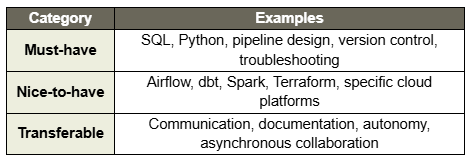
This prevents companies from rejecting strong candidates simply because they lack one particular tool while possessing equivalent experience and strong engineering fundamentals.
Evaluate Real-World Data Engineering Experience
A long list of technologies on a résumé does not necessarily demonstrate proficiency. Focus instead on how candidates applied those technologies to real business and engineering problems.
Look for evidence involving:
- Data volumes and sources.
- Pipeline execution frequency.
- Processing times and performance improvements.
- Data quality problems resolved.
- Cloud services used and why they were selected.
- Architecture decisions.
- Monitoring, alerting, and failure recovery.
- Sensitive-data or compliance requirements.
- Measurable improvements in speed, reliability, or infrastructure costs.
“Experience with AWS,” for example, provides little context. A stronger candidate might explain that they designed a pipeline using AWS Glue and Amazon Redshift to process millions of daily records while reducing reporting refresh time from four hours to 40 minutes.
Repositories, notebooks, technical articles, and personal projects can provide additional evidence when available, provided candidates respect previous employers' confidentiality.
Design a Relevant Technical Assessment
A data engineer technical assessment should resemble the work the candidate will actually perform.
Avoid relying primarily on syntax memorization, obscure algorithms, or theoretical questions unless they directly relate to the position.
Instead, present realistic engineering scenarios.
What Should a Data Engineer Technical Assessment Include?
Depending on the position, candidates might be asked to (AWS):
- Write or optimize SQL queries.
- Transform raw data into a usable model.
- Design a batch or streaming pipeline.
- Identify data quality problems.
- Debug a failing workflow.
- Explain a proposed cloud architecture.
- Design monitoring and observability strategies.
- Address security or governance requirements.
An initial assessment of approximately 30–60 minutes can evaluate core competencies without creating an excessive burden. If a longer take-home assignment is necessary, communicate the expected time commitment clearly.
Interfell's SPK assessment platform, developed by Simera, can also support standardized technical evaluations when companies need a more structured assessment process.
Use an Objective Candidate Scoring Rubric
A scoring rubric helps interviewers compare candidates consistently and reduces the influence of subjective impressions.
Each evaluator should assess the same core competencies and support scores with observable evidence.
Sample Data Engineer Evaluation Rubric
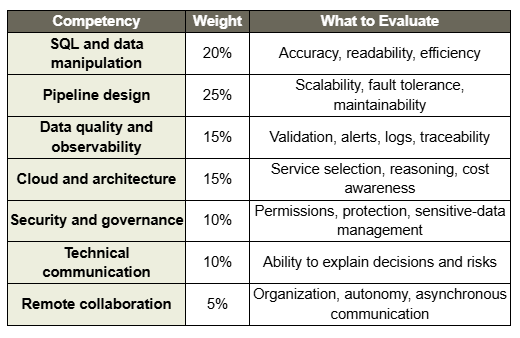
Weights should reflect business needs. A startup creating its first data platform may emphasize architecture and autonomy, while a regulated organization may prioritize security, governance, quality, and traceability.
The U.S. Equal Employment Opportunity Commission recommends analyzing job functions and competencies, developing objective job-related criteria, and applying those criteria consistently (U.S. EEOC).
Structure the Technical Interview
A good data engineer technical interview reveals how candidates think rather than simply testing whether they know a predetermined answer.
Useful questions include:
- How would you design a pipeline using multiple data sources?
- How would you investigate duplicate production records?
- What would you do if upstream data arrived late?
- When would you choose batch over streaming?
- How would you reduce pipeline infrastructure costs?
- How would you protect sensitive information?
- Describe a production data incident you handled.
Evaluate the candidate's assumptions, trade-offs, reasoning, and ability to adapt when requirements change.
Strong engineers should explain not only what they would do, but why.
Assess Remote Work Readiness
Technical expertise alone does not guarantee success in a distributed environment.
Remote engineering teams depend on documentation, ownership, communication, and effective asynchronous collaboration.
Ask candidates how they:
- Document architecture and technical decisions.
- Communicate blockers.
- Collaborate across time zones.
- Prioritize work independently.
- Handle ambiguous requirements.
- Coordinate during production incidents.
For U.S. companies hiring remote data engineers in Latin America, geographic proximity and time-zone compatibility can facilitate real-time collaboration. However, communication habits, accountability, and autonomy should still be evaluated explicitly.
Reduce Bias in the Hiring Process
Standardization can improve both fairness and hiring quality.
Candidates applying for the same role should receive comparable core questions and be evaluated against consistent, job-related criteria.
Avoid allowing educational pedigree, recognizable employer names, personal similarity, or unrelated characteristics to influence technical evaluations.
Interviewers should also understand relevant employment requirements. In the United States, EEOC guidance provides information about discriminatory hiring practices and inappropriate interview questions (U.S. EEOC).
Structured hiring does not require every interview to be identical. Follow-up questions can vary according to a candidate's experience, but the fundamental competencies being measured should remain consistent.
Validate References and Plan Onboarding
When appropriate, reference checks can validate previous responsibilities, reliability, collaboration style, and professional performance.
Ask focused questions such as:
- What responsibilities did the candidate own?
- How did they respond to system failures?
- How effectively did they communicate?
- In what environment did they perform best?
Once the candidate is selected, convert evaluation criteria into measurable onboarding goals.
30, 60, and 90 Day Objectives
Early objectives might include:
- Understanding the existing architecture.
- Taking ownership of a pipeline.
- Improving monitoring.
- Fixing a known data quality problem.
- Proposing an infrastructure optimization.
Compensation should also reflect current market conditions. Companies hiring across Latin America can use Interfell's 2027 Smart Hiring Salary Guide for LATAM as additional context for competitive offers.
A Final Word
Evaluating data engineering candidates requires more than reviewing technical keywords. The strongest hiring processes combine practical experience, relevant assessments, structured interviews, objective scoring, and evaluation of communication and remote-work capabilities.
For U.S. companies hiring remote professionals from Latin America, a consistent process can improve hiring decisions while simplifying integration across countries, cultures, and time zones.
The goal is not to hire the person who lists the most technologies. It is to identify a professional who can make sound technical decisions, explain their reasoning, build sustainable data systems, and generate measurable business value.
Ready to hire the data engineering talent your company needs?
Contact Interfell and discover how we can help you build high-performing remote IT teams across Latin America.
Interfell Related Articles
-
How to Hire a Data Engineer in LATAM Without Compromising Your Systems
-
Where to Hire AI Engineers in LATAM: Costs, Countries & Availability
FAQs
1. What skills should companies look for in a data engineer?
SQL, Python, data modeling, pipelines, ETL/ELT, cloud platforms, troubleshooting, data quality, and version control are common fundamentals.
2. How should you evaluate a data engineer?
Combine résumé screening, project evidence, practical assessments, scenario-based interviews, objective scoring, and communication evaluation.
3. How long should a technical assessment take?
An initial assessment of 30–60 minutes is usually sufficient for evaluating core skills.
4. What are good data engineer interview questions?
Focus on pipeline design, SQL optimization, data quality, production incidents, security, monitoring, cloud costs, and batch versus streaming decisions.
5. How do you evaluate a senior data engineer?
Assess architecture, scalability, reliability, security, cloud expertise, cost awareness, observability, leadership, and technical decision-making.
6. What should U.S. companies assess when hiring LATAM data engineers?
Evaluate technical expertise, English communication when required, time-zone compatibility, autonomy, documentation, accountability, and remote collaboration.
7. Why use a hiring scoring rubric?
A rubric makes candidate comparisons more consistent, focuses decisions on job-related evidence, and helps reduce subjective bias.
Quick Glossary
- Data Engineer: Professional responsible for designing, building, maintaining, and optimizing systems that collect, transform, store, and deliver data.
- ETL: Extract, Transform, Load—a process for extracting data, transforming it, and loading it into a target system.
- ELT: Extract, Load, Transform—a model where raw data is loaded before transformation.
- Data Pipeline: Automated sequence that moves and processes data between systems.
- Data Warehouse: Centralized repository optimized for analytics and reporting.
- Data Lake: Storage environment designed to hold large quantities of structured and unstructured data.
- Lakehouse: Architecture combining characteristics of data lakes and data warehouses.