


Summary
Successfully onboarding remote AI engineers requires more than creating accounts and sharing documentation. Companies need a structured process that combines technical readiness, clear communication, measurable goals, security, and team integration.
Want to see real profiles? Browse AI and machine learning engineers in Latin America with video and salary ranges on Interfell's talent search.
For U.S. companies hiring AI talent from Latin America, effective onboarding can accelerate productivity and help distributed teams collaborate successfully. This guide covers the essential steps—from preparing access before day one to creating a 30-60-90 day plan and measuring results.
Table of Contents
- Introduction
- How to Onboard a Remote AI Engineer
- Prepare Before Day One
- Create a Structured Learning Path
- Assign an Onboarding Buddy
- Set Communication Rules
- Connect AI Work to Business Goals
- Build a 30-60-90 Day Plan
- Integrate AI Security and Governance
- Strengthen Cultural Integration
- Measure Onboarding Success
- Conclusion
- Related Interfell Articles
- FAQs
- Brief Glossary
Introduction
Successfully onboarding remote AI engineers takes more than providing tools and technical documentation. To help new hires contribute quickly, companies need technical clarity, structured communication, measurable expectations, security standards, and meaningful team integration.
Demand for AI professionals continues to grow. The U.S. Bureau of Labor Statistics projects strong employment growth in data- and software-related occupations between 2024 and 2034, while the World Economic Forum identifies AI, big data, networks, and cybersecurity among the fastest-growing skill areas (BLS).
For U.S. companies, hiring AI talent in Latin America can expand access to specialized professionals. But recruiting the right person is only the beginning. A well-designed onboarding process is what turns a strong hire into a productive team member.
How to Onboard a Remote AI Engineer
Effective onboarding begins before the employee's first day. Companies should prepare tools and access, explain the business and technical architecture, assign an onboarding buddy, establish communication guidelines, and define measurable goals for the first 30, 60, and 90 days.
Security policies, data governance, approved AI tools, and early performance indicators should also be part of the process.
The goal is to reduce the time between hiring an engineer and enabling that professional to deliver meaningful business value.
Prepare Before Day One
If an engineer spends the first few days waiting for credentials, permissions, or repository access, productivity is already being delayed.
Before the start date, prepare:
- Equipment and required software.
- Repository and development environment access.
- Cloud, database, and AI tool credentials.
- Communication and project management platforms.
- Technical documentation and internal policies.
- Relevant meetings and contacts.
- Direct manager and onboarding buddy.
- Initial 30-60-90 day objectives.
Permissions should match the responsibilities of the role, particularly when engineers work with confidential data, proprietary code, or production models.
Multi-factor authentication should also be enabled. CISA recommends zero-trust approaches that verify access requests and limit resources according to actual needs (CISA).
Create a Structured Learning Path
A folder full of links is not an onboarding strategy. New engineers need to know what to learn first and how that knowledge connects to their responsibilities.
A useful learning path should cover:
- The business: products, customers, and goals.
- The AI problem: what business need the system solves.
- The architecture: services, dependencies, and data flows.
- The AI lifecycle: training, validation, deployment, and monitoring.
- Working standards: coding, testing, documentation, and delivery.
- Security: permitted data, models, tools, and providers.
- The first task: a concrete assignment with limited scope.
Architecture diagrams, recorded walkthroughs, glossaries, and technical decision records can complement written documentation.
For remote AI teams, these resources reduce unnecessary meetings and make knowledge available across different working hours.
Assign an Onboarding Buddy
Managers should not be the only people answering questions.
An onboarding buddy can help the engineer understand team dynamics, identify internal experts, select the appropriate communication channels, and review early contributions.
The buddy does not replace the manager. Instead, they provide an accessible point of reference during the first few weeks.
For teams distributed between the United States and Latin America, establishing a reasonable daily overlap window can also facilitate collaboration without requiring completely synchronized schedules.
Set Communication Rules
Remote teams cannot rely on informal office communication. Expectations need to be explicit.
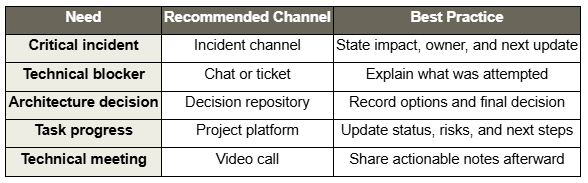
Asynchronous communication does not mean working alone. It means ensuring that important information remains accessible when colleagues are not online simultaneously.
Done well, asynchronous communication reduces unnecessary meetings and protects focused engineering time.
Connect AI Work to Business Goals
AI engineers perform better when they understand the business impact of their technical decisions.
Managers should explain:
- What problem the model solves.
- Who uses its outputs.
- Which KPIs define success.
- Which errors are critical.
- How production performance is evaluated.
A model may perform well in testing but provide limited value if it generates too many false positives, responds too slowly, or produces results users cannot interpret.
The engineer's first assignment should therefore be small but meaningful—for example, documenting a pipeline, adding a monitoring metric, improving data validation, or fixing an automated test.
The objective is to verify that the engineer can navigate the system, collaborate effectively, and complete an end-to-end work cycle.
Build a 30-60-90 Day Plan
A 30-60-90 day onboarding plan gives both the engineer and manager clear expectations.
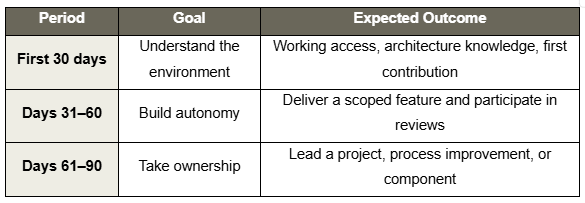
Goals should be observable. Instead of "become familiar with the platform," use a target such as: "Document the inference service's data flow and identify potential improvements."
Check-ins after the first week, first month, and first 90 days can help identify blockers before they affect performance.
Need specialized technology talent? Interfell helps U.S. companies identify and manage professionals across Latin America to build remote teams aligned with their technical needs.
Integrate AI Security and Governance
AI engineers may work with personal data, customer information, proprietary models, and external AI services. Security therefore needs to be part of onboarding from day one.
Engineers should understand:
- Which data is confidential.
- What cannot be entered into external AI assistants.
- How credentials and secrets are managed.
- Which AI models and providers are approved.
- Which changes require review.
- How incidents and vulnerabilities are reported.
The NIST Generative AI Profile highlights risks involving privacy, security, intellectual property, inaccurate information, bias, and third-party components (NIST).
These principles should become practical internal policies rather than abstract guidelines.
Strengthen Cultural Integration
Remote work does not eliminate the need for belonging.
Introduce new engineers through the appropriate channels, explain how the team operates, facilitate contextual conversations, and recognize early contributions.
Administrative expectations should also be transparent, including working hours, holidays, availability, contract terms, payment processes, and support channels.
A specialized partner can simplify these processes. Interfell, a consulting firm specializing in IT Recruitment, Remote Staffing, and Talent Management, has more than a decade of experience operating across Latin America, Spain, and the United States.
Measure Onboarding Success
Companies should track onboarding to identify friction and continuously improve the process.
Useful metrics include:
- Time to first approved code change.
- Time to first production delivery.
- Blockers during the first 30 days.
- Percentage of access enabled before day one.
- Completion of 30-60-90 day goals.
- Engineer and manager feedback.
- Six- and twelve-month retention.
Avoid measuring performance solely by commits. In AI engineering, documentation, experiment reproducibility, risk reduction, collaboration, and technical decision-making are also valuable indicators.
Companies can also use Interfell's Smart Hiring Salary Guide 2027 for Latin America to compare profiles, seniority levels, and markets before hiring.
Conclusion
Successfully onboarding remote AI engineers means turning informal knowledge into clear, repeatable, and measurable processes.
Pre-onboarding preparation, structured documentation, mentorship, asynchronous communication, progressive goals, and security policies help engineers become productive faster without sacrificing quality.
Talent evaluation can also be strengthened through SPK (Simera Professional Key), an AI-powered tool developed by Simera to automate candidate assessment and support better talent identification.
For U.S. companies, hiring technology talent from Latin America can expand access to specialized professionals and provide greater workforce flexibility. But successful remote hiring does not end when a contract is signed—it depends on how effectively new talent is integrated.
Ready to build your next AI team?
Discover how Interfell can help your company identify, evaluate, and onboard specialized technology talent from Latin America.
Related Interfell Articles
- Bbbbbbb
- bbbbbbbb
FAQs
1. How long should remote AI engineer onboarding take?
A structured onboarding process typically covers the first 90 days, progressing from learning the environment to greater autonomy and technical ownership.
2. What should be ready before the engineer's first day?
Hardware, software, repository access, cloud credentials, development environments, documentation, communication tools, security permissions, and initial objectives should be prepared in advance.
3. Why use a 30-60-90 day onboarding plan?
It turns broad expectations into measurable milestones and gives both engineers and managers a clear definition of progress.
4. How can U.S. and Latin American teams collaborate effectively?
Strong asynchronous communication, documented decisions, clear response expectations, collaboration tools, and a reasonable overlap window help distributed teams work efficiently.
5. What AI security topics should onboarding include?
Data confidentiality, credential management, approved AI tools, external AI policies, access controls, review procedures, and incident reporting should all be covered.
6. How should companies measure onboarding success?
Useful indicators include time to first contribution, early blockers, 30-60-90 day goal completion, feedback, and retention.
7. Why hire AI talent from Latin America?
Latin America can expand the pool of specialized technology professionals available to U.S. companies, particularly those building distributed or remote engineering teams.
Brief Glossary
- Asynchronous Communication: Collaboration that does not require team members to be online simultaneously.
- AI Governance: Policies and controls governing how AI systems are developed, deployed, and monitored.
- 30-60-90 Day Plan: A framework defining progressive goals during an employee's first three months.
- MFA: Multi-factor authentication, which requires multiple forms of identity verification.
- Model Monitoring: Continuous evaluation of an AI model's behavior after deployment.
- Reproducibility: The ability to recreate an experiment, environment, or result using documented processes.
- Zero Trust: A security approach that continuously verifies access rather than automatically trusting users or devices.