

.png?width=900&height=506&name=How%20to%20hire%20a%20Full%20Stack%20Developer%20(and%20avoid%20common%20mistakes).png)
Summary
Hiring a remote full-stack developer in LATAM can help U.S. companies expand engineering capacity while maintaining strong time-zone overlap and competitive costs.
Want to see real profiles? Browse full stack developers in Latin America with video and salary ranges on Interfell's talent search.
Success depends on more than technical skills. Companies need to define the role clearly, validate real-world abilities, evaluate remote communication, benchmark compensation, choose the right hiring model, and create a structured onboarding plan.
This guide explains how to hire a full stack developer, which skills to prioritize, what mistakes to avoid, and how to build an effective remote hiring process.
Table of Contents
- Introduction
- Full Stack Developer Skills You Should Require in 2026
- The 5 Most Common Hiring Mistakes—and How to Avoid Them
- Average Full Stack Developer Salaries in 2026
- Recommended Hiring Process: Step by Step
- 30-60-90 Day Onboarding for Remote Developers
- Why LATAM Is Strategic for U.S. Companies
- Final Thoughts: Are You Ready to Scale Your Tech Team?
- Related Articles from Interfell
- FAQs
- Brief Glossary
Introduction
A full-stack developer works across both the frontend and backend of an application (Built-in).
Typical responsibilities include:
- Building interfaces with HTML, CSS, JavaScript, TypeScript, React, Angular, or Vue.
- Developing backend services with Node.js, Python, Java, .NET, or similar technologies.
- Creating and integrating APIs.
- Working with SQL or NoSQL databases.
- Testing, debugging, and reviewing code.
- Supporting cloud deployment and CI/CD workflows.
- Collaborating with product, design, QA, and DevOps teams.
Full stack does not mean “expert in everything.” Strong candidates usually have deeper expertise in one part of the stack while remaining productive across the application.
Before hiring, define which technologies require deep expertise and which only require working knowledge.
Full Stack Developer Skills You Should Require in 2026
Technical Skills
Look for experience relevant to your actual product:
Frontend
- JavaScript and TypeScript
- React, Angular, Vue, or another modern framework
- Responsive interfaces and API integration
Backend
- Node.js, Python, Java, .NET, or your primary stack
- REST or GraphQL APIs
- Authentication and authorization
Databases
- PostgreSQL, MySQL, SQL Server, MongoDB, or similar
- Data modeling and query optimization
Cloud and DevOps
- Git
- Docker
- CI/CD
- AWS, Azure, or Google Cloud
Security
Candidates should understand secure authentication, access control, input validation, dependency management, and common web vulnerabilities.
Remote Work Skills
Technical ability alone is not enough. Evaluate:
- Written and verbal communication
- Ownership
- Problem-solving
- Documentation
- Time management
- Adaptability
- Ability to work asynchronously
- Giving and receiving feedback
Bonus Skills
Useful additional capabilities include:
- AI and LLM integrations
- AI-assisted development workflows
- Microservices
- Event-driven architecture
- Automated testing
- Observability
- Infrastructure as code
The 5 Most Common Hiring Mistakes—and How to Avoid Them
1. Hiring Too Fast Without Technical Validation
A strong résumé does not guarantee strong performance.
How to avoid it: Use a realistic technical assessment such as a coding task, code review, debugging exercise, API challenge, or system-design discussion.
Test candidates on work they will actually perform rather than relying only on algorithm puzzles.
2. Not Clearly Defining Seniority
Years of experience should not be the only measure of seniority.
- Junior: Handles straightforward tasks with guidance.
- Mid-level: Works independently on features and APIs.
- Senior: Makes architectural decisions, manages ambiguity, mentors others, and owns complex technical outcomes.
How to avoid it: Create a competency scorecard before interviews begin.
3. Ignoring Communication and Remote Collaboration
Remote engineers need to communicate blockers, document decisions, explain tradeoffs, and collaborate without constant meetings.
How to avoid it: Ask scenario-based questions such as:
- How do you communicate when a deadline is at risk?
- What do you do when requirements are unclear?
- How do you handle technical disagreement?
Evaluate observable behaviors rather than vague “cultural fit.”
4. Offering Non-Competitive Compensation
LATAM is not one salary market. Compensation varies by country, seniority, stack, English level, international experience, and hiring model.
How to avoid it: Use current market benchmarks such as Interfell's Smart Hiring 2027 Salary Guide before opening the role.
5. Ignoring Legal and Financial Compliance
International hiring may involve worker classification, payroll, taxes, intellectual property, and local labor requirements.
Common models include:
- Independent contractor
- Employer of Record (EOR)
- Local entity
- Staffing partner
How to avoid it: Define the hiring model before making an offer and obtain appropriate legal or tax guidance.
Average Full Stack Developer Salaries in 2026
Full stack developer compensation varies significantly across LATAM.
Instead of using one regional average, compare salaries according to:
- Country
- Seniority
- Technology stack
- English proficiency
- International experience
- Employee or contractor status
U.S. developer compensation is generally higher than many LATAM market benchmarks, but companies should avoid promising one universal percentage of savings.
A realistic cost comparison should also include benefits, taxes, recruiting fees, equipment, compliance, and retention.
For current country-by-country benchmarks, use Interfell's Smart Hiring 2027 Salary Guide.
Recommended Hiring Process: Step by Step
1. Define the Role
Document:
- Primary frontend and backend stack
- Seniority
- Cloud environment
- Responsibilities
- English requirements
- Working-hour overlap
- Compensation range
- Hiring model
Separate must-have skills from nice-to-have technologies.
2. Source Candidates
Use channels such as LinkedIn, developer communities, referrals, specialized job boards, and LATAM-focused recruitment partners.
3. Run an Initial Screening
Review:
- Relevant project experience
- Technologies used in production
- Availability
- English level if required
- Location and time zone
- Compensation expectations
Do not automatically reject candidates without public GitHub activity; many experienced developers work on private repositories.
4. Use a Realistic Technical Assessment
A useful full-stack exercise could ask candidates to:
- Build or modify an API.
- Connect it to a database.
- Display data in a frontend component.
- Add validation and error handling.
- Explain their technical decisions.
For senior roles, add questions about architecture, scalability, security, and technical tradeoffs.
AI-assisted tools such as SPK by Interfell can support structured candidate evaluation, but human technical judgment should remain part of the decision.
5. Evaluate Communication
Assess whether candidates can explain technical decisions, raise blockers early, work asynchronously, document clearly, and collaborate with technical and non-technical stakeholders.
6. Make a Clear Offer
Include:
- Compensation and currency
- Benefits
- Contractor or employee status
- Working hours
- Time-zone expectations
- Equipment
- Start date
- Review cycle
Transparency reduces declined offers and misunderstandings.
7. Create Structured Onboarding
Remote hiring does not end when the candidate signs.
Prepare access, documentation, team introductions, initial tasks, and clear performance expectations before Day 1.
30-60-90 Day Onboarding for Remote Developers
First 30 Days: Learn
- Set up tools and access.
- Review architecture and documentation.
- Assign an onboarding buddy.
- Complete a low-risk first task.
- Schedule regular manager 1:1s.
Days 31–60: Contribute
- Ship features independently.
- Participate in code reviews.
- Work with product and QA.
- Improve technical documentation.
Days 61–90: Own
- Take responsibility for a feature or module.
- Participate in architecture discussions.
- Identify improvements.
- Complete a formal 90-day review.
Schedule the 30-, 60-, and 90-day check-ins before the developer starts.
LATAM vs. U.S. Hiring Advantages
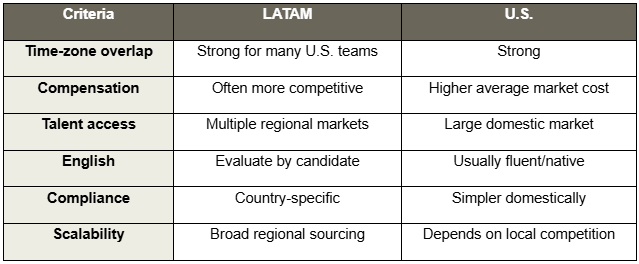
Sources :(Reddit)(Blog.Nexton)
LATAM's value is not simply lower cost. Its strongest advantage is the combination of talent access, working-hour alignment, compensation flexibility, and distributed-team scalability.
Why LATAM Is Strategic for U.S. Companies
LATAM can be attractive for U.S. technology teams because many developers work within overlapping business hours.
That makes activities such as stand-ups, code reviews, product discussions, pair programming, and incident response easier than with teams separated by large time differences (Latojobs).
The region also expands recruiting beyond one domestic market, giving companies access to developers experienced in widely used technologies such as React, TypeScript, Node.js, Python, Java, .NET, AWS, and DevOps tools.
However, companies should not treat LATAM as one homogeneous talent market. Compensation, English proficiency, specialization, and candidate availability vary by country.
The goal should be to find the best combination of talent quality, collaboration, and total hiring value, not simply the lowest salary.
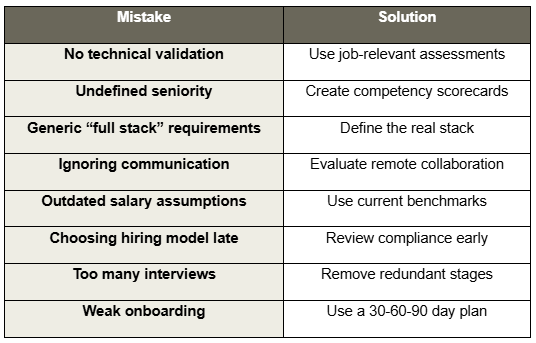
Common Hiring Mistakes vs. Recommended Solutions
Final Thoughts: Are You Ready to Scale Your Tech Team?
Hiring a remote full-stack developer in LATAM can expand your engineering capacity while supporting real-time collaboration with U.S. teams (Howdy).
The strongest hiring processes follow a simple principle: define the role clearly, evaluate real skills, benchmark compensation carefully, and create the conditions for the developer to succeed after joining.
Interfell supports companies hiring technology professionals across LATAM through recruitment expertise, market intelligence, structured evaluations, SPK by Interfell, and the Smart Hiring 2027 Salary Guide.
Ready to build your remote engineering team? Connect with Interfell to find vetted LATAM full stack developers and create a hiring process based on evidence, not just résumés.
Related Articles from Interfell
-
Why are US companies now hiring Full-Stack Developers in LATAM?
-
How to Integrate LATAM Remote Developers into U.S. Agile Teams?
FAQs
1. How do you hire a remote full stack developer?
Define the stack, responsibilities, seniority, compensation, and working hours. Then screen candidates, validate technical skills, evaluate remote communication, and provide structured onboarding.
2. What skills should a full stack developer have?
Most roles require frontend development, backend programming, APIs, databases, Git, testing, cloud fundamentals, and application-security awareness.
3. How much does a full stack developer cost in LATAM?
Costs vary by country, seniority, stack, English proficiency, and hiring model. Use current country-specific salary benchmarks rather than one regional average.
4. How should you test a full stack developer?
Use a realistic exercise involving an API, database, frontend component, validation, testing, debugging, or code review. Senior candidates should also discuss architecture and scalability.
5. Is LATAM a good region for remote developers?
Yes, especially for U.S. companies seeking broad technology talent and substantial working-hour overlap. Individual markets and candidates should still be evaluated separately.
6. Should LATAM developers be contractors or employees?
Either can work. The correct structure depends on local law, taxes, benefits, worker classification, and the nature of the relationship.
7. How long should developer onboarding take?
Use approximately 90 days: learning during the first 30, independent contribution during days 31–60, and broader ownership during days 61–90.
Brief Glossary
- Full Stack Developer: Developer who works across frontend and backend systems.
- Frontend: User-facing part of an application.
- Backend: Server-side logic, APIs, databases, and integrations.
- EOR: Employer of Record; a third party that legally employs workers for another company.
- Nearshoring: Hiring talent in geographically closer countries with compatible working hours.
- Technical Assessment: Structured evaluation of job-relevant technical skills.
- Time-Zone Overlap: The portion of the workday during which distributed team members in different geographic regions are simultaneously available.
Hiring in Latin America? See salary bands, time zones and contracts in hire full stack developers in Colombia and the LATAM IT salary guide. Hiring outside LATAM? Our sister company Simera covers it in its global full stack hiring guide.